The Missing Link: Nerang to Broadbeach Public Transport Corridor
Detailed investigations underway. Mode not yet confirmed. Mode decision and funding announcements pending 2026–27.
The Missing Link: Nerang to Broadbeach Public Transport Corridor
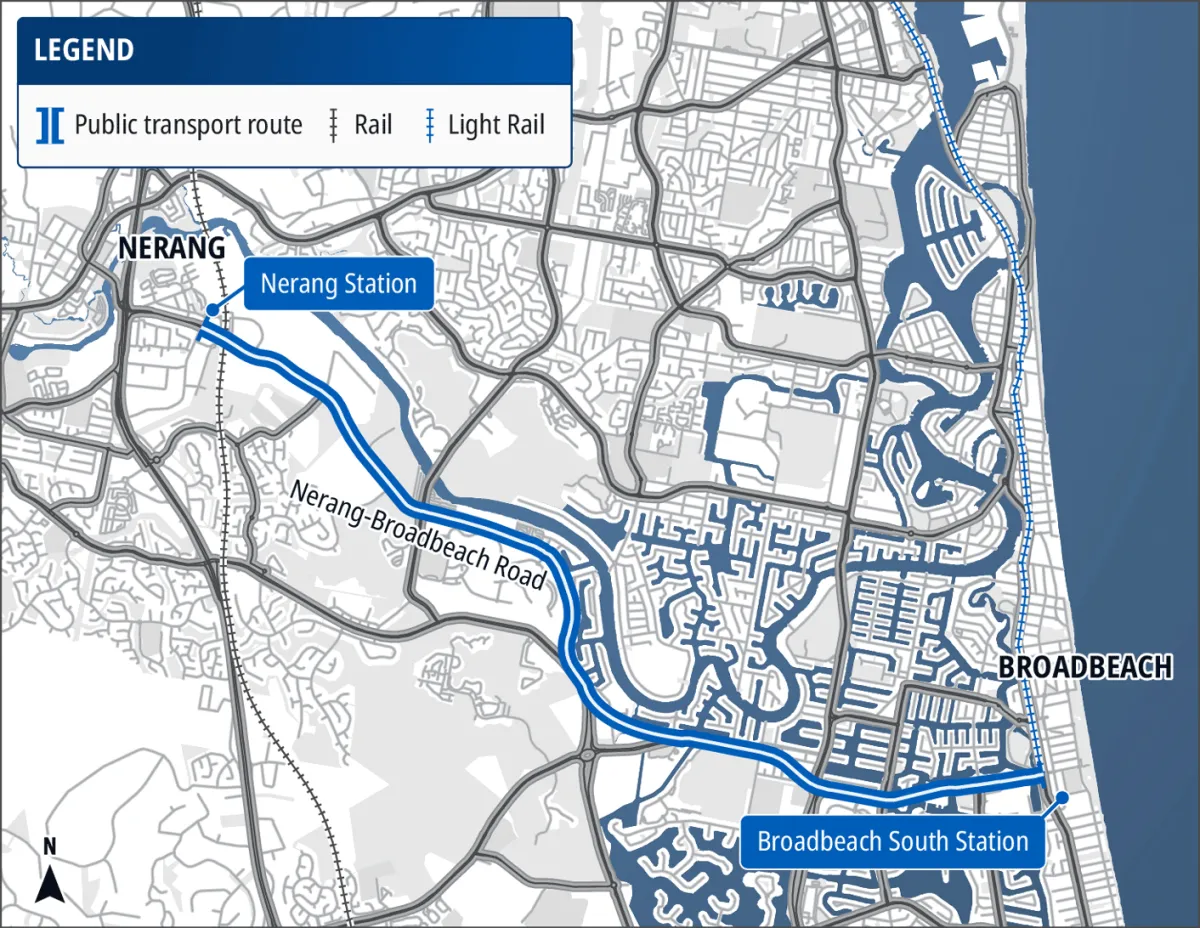
Status: Detailed investigations underway Mode: Not yet confirmed (bus rapid transit or fixed rail options under study) Route: Nerang Station → Carrara → Mermaid Waters → Broadbeach South Station (~east-west corridor) Estimated completion of investigations: 2026–2027
What Is the Nerang to Broadbeach Corridor?
The Gold Coast's public transport network has a well-known structural gap: excellent north-south coverage along the coast (light rail, heavy rail, bus), but very poor east-west connectivity linking the inland suburbs to the beachside corridor.
The Nerang to Broadbeach Public Transport Route is the Queensland Government's proposed solution to the most significant of these east-west gaps. The corridor would connect:
- Nerang Station — an existing heavy rail station on the Gold Coast line, providing connections to Brisbane and all points north - Carrara — including the Carrara Markets precinct and the Queensland Sport and Athletics Centre (Carrara Stadium), a key sporting venue for the region and a 2032 Olympic Games site - Mermaid Waters — a large residential suburb currently underserved by rapid transit - Broadbeach South Station — the current southern terminus of the light rail network (being extended to Burleigh Heads in mid-2026)
The corridor runs broadly east-west along Nerang-Broadbeach Road and Hooker Boulevard, covering a distance of approximately 10–12 kilometres.
Why Does This Corridor Matter?
Currently, residents in Carrara, Mermaid Waters, and western Broadbeach areas face a fragmented public transport experience. Getting from Nerang Station to Broadbeach South by bus — on the Route 745 service — takes approximately 20 minutes in off-peak conditions, and significantly longer during events or peak traffic.
For a city that will host significant Olympic events in 2032 and has one of the country's largest and most active sporting precincts at Carrara, this east-west gap has real consequences:
- Carrara Stadium (capacity ~25,000 for events) has poor mass transit access from Brisbane or the coast - Residents of Carrara, Merrimac, and Mermaid Waters cannot easily access either the heavy rail network at Nerang or the light rail network at Broadbeach without a car - The Gold Coast Hospital and Health Service campuses in the Carrara precinct are major employment hubs with limited transit options
A rapid transit connection would unlock fast, frequent, car-free access between two nodes of the Gold Coast's transport network — and transform the liveability of the suburbs in between.
How Did This Project Come About?
In 2023, TMR Queensland completed the Central Gold Coast East-West Passenger Transport Study, which examined the case for rapid transit corridors running east-west across the central Gold Coast. The study identified two priority corridors:1
1. Nerang to Broadbeach (this project) 2. Robina to Miami (a separate corridor under consideration)
Both corridors are part of the Queensland Government's 2032 Delivery Plan, which aims to improve transport and support the Brisbane 2032 Olympic and Paralympic Games.1,7 The Nerang to Broadbeach corridor then entered a detailed investigation phase — examining alignment options, mode choices, station locations, and cost estimates.
What Mode Will It Be?
No final decision has been made. TMR is currently focused on investigating high-frequency bus services and supporting infrastructure as the primary option for the corridor.1 Broader mode options under consideration include:
Bus Rapid Transit (BRT): Dedicated bus lanes along the Nerang-Broadbeach Road and Hooker Boulevard corridor. Lower capital cost, faster to deliver, but limited capacity for surge events such as the Olympic Games or major concerts at Carrara Stadium.
Light Rail: Fixed track tram service, potentially integrating with or connecting to the existing G:link network. Higher capacity and perceived amenity, but significantly higher cost and longer delivery timeline.
No construction cost has been publicly announced — the project remains in the investigation and feasibility phase.1
Regardless of the ultimate mode, the Queensland Government has committed to bus priority measures on this corridor as part of the 2032 Games transport plan — meaning some level of improvement is committed even if the full rapid transit project is not delivered before the Games.7
An Early Win: Dedicated Bus Lanes
A dedicated bus lane component along Nerang-Broadbeach Road has been progressed as an early infrastructure improvement. This provides some uplift to east-west bus journey times and creates early infrastructure that can support a future BRT or higher-order service.
The 2032 Olympic Games Connection
The Nerang to Broadbeach corridor is explicitly listed in the Queensland Government's 2032 Delivery Plan as part of the Games transport legacy.7 Its significance is direct:
The Carrara Sports Precinct — home to Gold Coast Stadium and the Queensland Sport and Athletics Centre — is a confirmed 2032 Olympic venue. The precinct sits almost exactly at the midpoint of the proposed Nerang-Broadbeach corridor.
For the Games to work without massive car-dependent traffic congestion in the Carrara/Mermaid Waters area, some form of improved east-west rapid transit is essential. Event spectators coming from Brisbane on heavy rail need to reach Carrara from Nerang; those on light rail from the coast need to reach it from Broadbeach South.
The corridor solves both access requirements in a single project.
What to Watch
- Detailed investigation completion (2026–27): The study — currently underway — will define the preferred mode, alignment, station locations, and cost.1 This is the key decision point. No changes to this timeline have been publicly announced. - Mode confirmation: The major trigger for this project. TMR is actively investigating high-frequency bus services, but no mode has been locked in. - Funding commitment: Following the investigation, a funding announcement (or decision not to proceed) is required from the Queensland and/or Australian Government. No cost figure has been released. - Construction timeline: Even if a decision is made promptly after the investigation, construction of a quality rapid transit corridor typically takes 3–5 years. Delivery before 2032 would require a fast-tracked approach. - Bus service improvements: Interim improvements to Route 745 and priority measures are likely regardless of the longer-term project outcome.
What It Means for Property Owners
Suburbs in and around the proposed corridor — Carrara, Merrimac, Mermaid Waters, and western Broadbeach — are currently at a relative transport disadvantage compared to beachside suburbs on the light rail and coastal bus routes.
A confirmed rapid transit corridor would represent a significant structural improvement to the transport amenity of these suburbs — and historically, that kind of infrastructure confirmation has been associated with above-average property price performance in the lead-up to and following delivery.
No funding or construction has been committed. The project remains in the investigation phase. But the policy intent is clear, the Olympics timeline provides a genuine forcing mechanism, and the corridor has been identified in state planning instruments as a priority.
Sources
1. TMR Queensland (2026) Nerang to Broadbeach Public Transport Route, Department of Transport and Main Roads. tmr.qld.gov.au 7. Queensland Government (2026) Transport — The 2032 Delivery Plan, Delivering 2032. delivering2032.com.au
Article first published: February 2026. Last reviewed: 2 March 2026. Review triggers: detailed investigation findings (est. 2026–27); mode confirmation; any government funding announcements; 2032 transport planning updates.
Disclaimer: The information in this article is for general informational purposes only and does not constitute financial, investment, or valuation advice. Fields Real Estate (Licence No. 4832971) makes no warranty as to the accuracy or currency of data published. Readers should conduct their own due diligence and seek independent professional advice before making any property or investment decision. Read our full disclaimer →