The Highest-ROI Actions When Selling Your Gold Coast Home
Not all pre-sale spending is equal. Data-backed ranking of which actions move the needle on sale price — and which ones don't.

The Highest-ROI Actions When Selling Your Gold Coast Home
Seller Strategy | Fields Property Intelligence March 2026 | Will Simpson
Most sellers spend money on the wrong things.
They replace the kitchen splashback. They hire a staging company. They spend three weekends painting the fence. And they walk away from settlement wondering why the result felt flat — why, after all that effort and expense, the number didn't feel like everything it should have been.
The real answer is rarely about the house.
After reviewing property sales across the southern Gold Coast — Robina, Mudgeeraba, Varsity Lakes, Burleigh Waters, Worongary, Reedy Creek, Merrimac, Carrara, and Clear Island Waters — combined with peer-reviewed academic research and industry data, the pattern is consistent: the actions with the highest return when selling a home are almost never the expensive ones. The biggest levers are decisions, not renovations. Strategy, not splashback tiles.
Here is what the data shows actually moves the needle.
The Framework: Think in ROI, Not In Effort
Before getting into specifics, the single most useful shift a seller can make is to stop thinking about selling in terms of effort and start thinking in terms of return on investment.
Some actions cost nothing and protect or create enormous value. Others cost $40,000 and return $31,000. The goal is to identify which is which before you start — not after.
What follows is that hierarchy, built from real Gold Coast sales data, peer-reviewed academic research, and thirty years of experience distilled from industry practitioners including Andrew Winter, host of Selling Houses Australia.
Tier One: The Big Levers
These are the decisions with the highest potential impact. They cost little to nothing. They are almost entirely overlooked.
1. Pricing Strategy — The Single Most Important Decision You Will Make
Nothing a seller does has more impact on the final sale price than the number they choose to put on the property. Not the renovation. Not the staging. Not the photography. The price.
This is not intuitive. Most sellers believe their home's value is a fixed number — something "out there" in the market — and their job is simply to ask for it. But research across tens of thousands of transactions tells a different story.
A study published in Applied Economics, analysing over 25,000 Sydney home sales, found two consistent results: homes listed above their true market value take significantly longer to sell, and they ultimately achieve lower final prices than correctly-priced equivalents (Khezr 2015). A separate study covering 3,490 sales of detached dwellings reached the same conclusion: overpriced homes don't just sit — they eventually sell for less (Beracha & Seiler 2014).
The reason is a mechanism called the lemon zone. When a property sits on the market beyond roughly 45 to 60 days, the pool of active buyers draws a quiet conclusion: something must be wrong with it. The listing becomes stigmatised. Subsequent offers arrive anchored lower than they would have been on day one. The seller who "tested the market" at an inflated price often ends up selling for less than a seller who priced correctly from the start.
HVCO research notes captured this with a striking equivalence: "Overpricing one's home between 10 and 20 per cent relative to comparable properties has the same impact on the final sale price as increasing the size of the home by approximately 860 square feet." In other words, overpricing costs you a bedroom and a study — in value — without a single buyer noticing.
The flip side is equally counterintuitive. Underpricing does not create competition that drives the price up. Research across 14,000 transactions found that underpriced homes "systematically fared less well, even in hot markets" (Bucchianeri & Minson 2013). Empirical auction studies are more precise still: listing a property 10 per cent below estimated market value reduces the winning bid by approximately five per cent. The list price anchors buyer expectations. Set it too low, and that's where they stay.
What actually works is what the data consistently supports: a listing price set just below the logical market valuation — enough to capture every relevant buyer's attention without triggering the low-anchor effect. This generates maximum competition at the right price level. When a second motivated buyer enters the frame, that's when premium prices are made.
There is also a tactical precision effect. Cardella and Seiler (2016) found that listing at a precise number slightly above a round figure — for example, $1,201,000 rather than $1,200,000 — consistently produced higher final sale prices and smaller negotiated discounts. The precision signals confidence. Round numbers signal room to move.
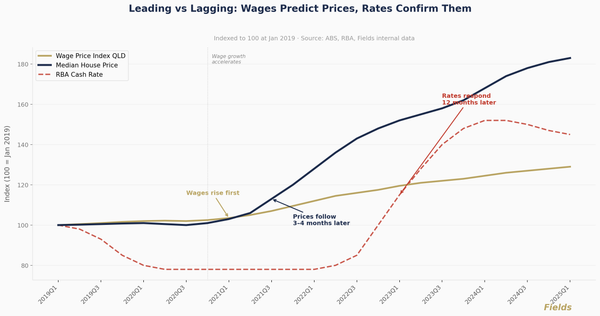
That precision matters more in the current Gold Coast market than it did three years ago. SQM Research tracked Gold Coast dwelling values surging approximately 18.0% in the 12 months to November 2025, pushing the city-wide median house price to a record high of roughly $1.4 million.1 At these price points, a one per cent pricing error is $14,000 — before negotiation. Getting the number right from day one is not a nicety; it is the primary financial act of the entire sale.
The southern Gold Coast suburbs covered by Fields reflect this. Across 2,147 house sales in the last 12 months, rolling 12-month medians range from $920,000 in Merrimac (221 sales) to $1,855,000 in Burleigh Waters (198 sales), with Reedy Creek at $1,500,000 (251 sales), Robina at $1,438,750 (268 sales), and Varsity Lakes at $1,280,000 (235 sales) — Fields internal data. That spread matters for pricing precision. The suburb you are in defines your comparable pool, and the bracket your property targets defines who you are competing against.
How to find the right price: 1. Identify the five to eight most comparable sold properties in your suburb from the last 90 days 2. Assess honestly where your property sits relative to them — not optimistically, but as a buyer would 3. Cross-check your range against automated valuation estimates from multiple platforms 4. Set your listing price just below that range — enough to generate interest, not so low that it anchors the negotiation
If you remain uncertain after doing this work, a licensed valuer costs $300 to $500 and produces a defensible, independent figure. That's an extremely cheap insurance policy relative to what mispricing can cost.
2. Agent Selection — The Most Underestimated Variable
The most consequential decision a seller makes — after pricing — is who they choose to represent them.
Research distilled in Strategic House Price Maximisation found that the gap between a skilled and a mediocre agent can be as much as 20 per cent of the final sale price (Simpson 2024). On a Gold Coast property selling near the city-wide median of $1.4 million, that is a $280,000 difference from a decision that costs the seller nothing extra to get right.
Most sellers approach agent selection the wrong way. They choose the agent who sold the most homes in their suburb last year, reasoning that volume equals skill. Industry research tells a different story: high-volume agents do not systematically achieve high price premiums. In fact, lower-volume agents are disproportionately represented among top price-premium performers. The reason is simple — they have more time per listing. They build deeper relationships with buyers. They negotiate harder.
The agent archetype that reliably achieves premium prices operates differently from the one chasing turnover. A high-turnover agent's business model depends on volume — win the listing, take it to auction, move to the next. Their incentive is a quick sale, not the best sale. A premium-outcomes agent builds buyer relationships over weeks, understands each buyer's stretch budget, and knows precisely when a buyer has reached their emotional peak before asking for an offer. That timing is where premium prices are extracted.
A quick illustration of the maths: a one per cent commission on a $1.4 million property is $14,000. The difference between a mediocre sale price and a strong one on that same property is commonly five per cent or more — $70,000. Choosing the agent who charges half a per cent less, if they underperform on price, costs the seller more than $55,000 net. Cheap commission is one of the most expensive decisions in property.
How to assess agents properly: - Ask for their list-to-sale price ratio on recent comparable sales (not median price, which is heavily influenced by the properties they list, not their skill) - Ask for post-sale references, not pre-listing testimonials - Observe whether they provide a realistic, data-backed price estimate with comparable sales, or simply tell you what you want to hear - Be wary of any agent who appraises significantly higher than others without specific comparable evidence — this is a common tactic to win the listing, followed by pressure to reduce price once you are under contract
Andrew Winter, who has spent thirty years in real estate on three continents, is direct on this point: "The biggest price agent is likely the biggest liar. Look at the data. The data doesn't lie."
3. Marketing Investment — "You Cannot Sell a Secret"
Every buyer who does not know your property exists is a buyer who cannot compete for it. Every buyer who cannot compete is a few thousand dollars less in your pocket.
PropTrack research found that Brisbane properties sold off-market achieved 3.6 per cent less than equivalent properties listed on the major portals. In Sydney and Melbourne, that gap averaged more than $30,000 (PropTrack 2024). The cost of not marketing your property fully is not abstract — it is a direct deduction from your proceeds.
Premium listings on the major portals produce measurable uplift: 2.9 times more views, 2.6 times more email enquiries, 2.1 times more appearances in search results, and properties that sell ten days faster (REA Group 2024). In a market where holding costs on a $1.4 million mortgage run to roughly $5,500 to $7,500 per month, selling ten days faster is itself worth $1,800 to $2,500 — before the price premium from greater competition is counted.
There is also a buyer type most marketing strategies miss entirely. Every market contains both active buyers (checking listings daily, attending opens) and passive buyers (they know they want to move, they have a clear idea of what they want, but they are not actively searching — until the right property comes across their feed). In balanced markets, passive buyers represent 30 to 40 per cent of the pool. In softer markets, they can be the majority. Reaching them requires social media. It cannot be done through property portals alone.
That buyer pool remains broad right now. Days on market across many Gold Coast suburbs remain under 30,1 and staging and quality marketing can add 5–10% to final sale price in this environment.2 In fast-moving conditions, the listings that generate maximum early competition are the ones that reach both active and passive buyers simultaneously. Marketing reach is not a luxury — it is a direct driver of final price.
The vendor advertising debate: Many sellers instinctively resist paying for their own marketing. The internal maths, however, are unambiguous. If an agent bears the advertising cost and better marketing produces $200,000 more in sale price, the agent's net benefit from that extra advertising spend is roughly $1,000 (their additional commission minus the extra cost). The seller's net benefit is $191,000. The incentive structures point in opposite directions. Vendor-paid advertising is in the seller's interest.
Professional photography is the cheapest high-return line item in the entire marketing budget. Research finds that listings with professional photography receive 118 per cent more online views than those with poor-quality images. For most buyers in 2026, the photograph is the first viewing — the decision to inspect or skip is made on a screen. Photography costs $300 to $800. The cost of not having it is measured in open homes that don't happen.
4. First Offer Strategy — Don't Wait for a Better Offer That May Never Come
There is a common belief among sellers that early offers are exploratory — that the market will "warm up" over the coming weeks and better offers will follow. The data does not support this.
Research covering more than 4,500 property sales found that the majority of homes sell within the first two weeks of listing, and ten per cent sell within nine days (Rossini et al. 2012). Early buyers are not speculative — they are typically the most prepared buyers in the market, often having missed previous properties and motivated to act without hesitation.
The practical implication: if your home is correctly priced and well-presented, a strong offer in the first week is not a sign that you priced too low. It is a sign that you priced correctly and attracted a motivated buyer. Holding out on the assumption that patience will produce a higher offer carries a real cost — roughly $5,500 to $7,500 per month in holding costs on a $1.4 million property, compounding the longer you wait.
The framework for deciding: know your valuation range before you list. Know your premium price range. When an offer arrives, you will know immediately whether it falls within premium range (negotiate from strength or accept), within valuation range (negotiate), or below valuation (counter firmly). Informed sellers don't guess. They measure.
Tier Two: The Solid Returns
These actions matter. They compound the gains from Tier One. Done well, they protect against the most common reasons buyers discount.
5. Presentation — The "Sell As-Is or Go All In" Decision
Andrew Winter's most counterintuitive piece of selling advice has been tested across decades of observation: in any market of ten comparable homes, two immaculate move-in-ready properties sell fastest, and two very affordable original properties sell fast. The remaining six — the middle-of-road, partially updated homes — are the hardest to shift.
The danger zone is the middle. A moderate renovation — new kitchen handles, some fresh paint, replaced carpet in two rooms — does not move a property into the "immaculate" category. It moves it into the most difficult category to sell, at a price point that no longer offers the appeal of an affordable renovation project but doesn't deliver the confidence of a move-in-ready home.
This is not an argument for neglect. Selling as-is has a specific meaning: the home is clean, cleared, and honestly presented. That requires:
- Removing stained carpets, dated furniture, old appliances, and anything that is not fresh-smelling - Cleaning thoroughly — eaves, windows, fly screens, outdoor areas — so that the bones of the home are visible without distraction - Tidying outdoor areas to their full potential: mown lawns, cleared garden beds, empty sheds - Reclaiming any areas that pets have damaged
Andrew Winter documented the consequence of ignoring the last point with painful specificity: a property where dogs and chickens had damaged the garden and created an "almost unbearable" odour cost the sellers tens of thousands of dollars in lost value. The family-with-children buyer pool — the primary market for most Gold Coast homes — simply would not engage with it emotionally.
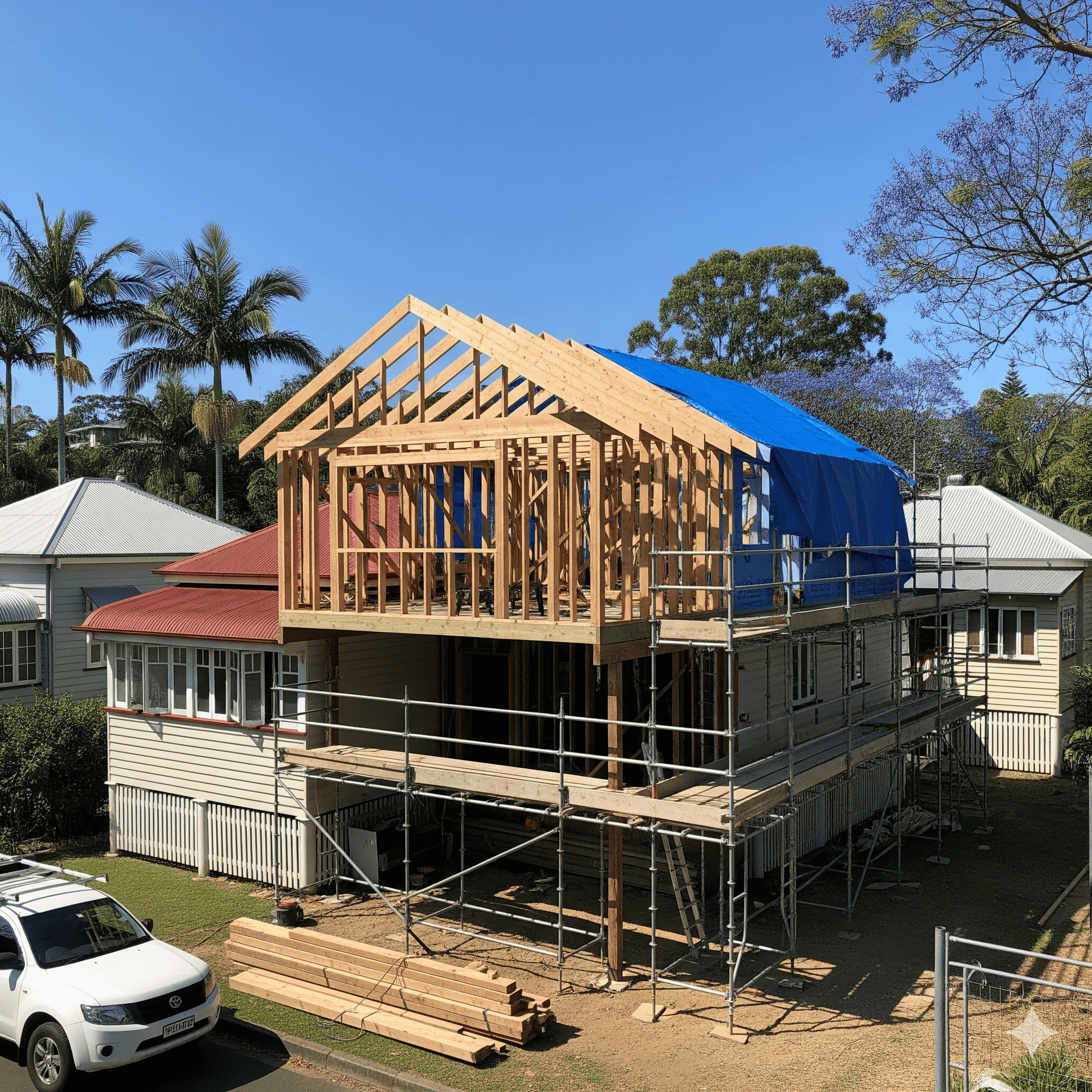
If full renovation is the decision: commit entirely. A half-finished renovation is the worst outcome of all. Buyers calculate: future value, minus renovation costs, minus contingency, minus the reward for their effort. The gap between seller and buyer valuation on a half-renovated property is consistently large and consistently painful.
What the renovation data actually shows: buyers in 2026 expect homes to be move-in ready.2 Kitchen and bathroom upgrades produce the most reliable returns when executed fully.
For kitchens, Gold Coast-based contractors and national research point consistently to a return on cost of 60–80%.3,4 A minor kitchen remodel — replacing cabinet fronts, hardware, benchtops, and appliances — can deliver around 77% ROI, with the cost sweet spot sitting between $15,000 and $40,000.4 A mid-range kitchen renovation at approximately $35,000 typically boosts property value by around $20,000 (57% ROI), while a more extensive overhaul at around $65,000 can yield a value increase of up to $40,000 (62% ROI).3 In competitive markets, a well-designed kitchen renovation can add up to 10% to market value.5
Bathroom renovations follow a similar pattern. A mid-range bathroom renovation on the Gold Coast typically costs between $15,000 and $30,000.6 Executed well, it can return 60–80% on cost.6 A dated bathroom is consistently cited as one of the most damaging buyer turn-offs; a clean, modern makeover delivers a solid ROI of 60–70%.3 Adding a second bathroom or powder room in an older home is one of the higher-return structural changes available, with estimated returns of 50–75% depending on finish and layout improvement.4
Outdoor living upgrades — alfresco areas, decks, and landscaping — remain high-ROI in Queensland specifically, where the climate makes outdoor space a genuine selling feature rather than an afterthought. A well-executed deck or alfresco area delivers an ROI of 60–100% in Australia, given it is treated as a genuine extension of the home's living space.7 A wooden deck alone delivers around 66% ROI; a patio approximately 55%.7 Professional landscaping of front yards typically costs $5,000–$15,000 but can add $20,000–$40,000 to perceived property value in the right markets,7 and a garden can increase a property's value by 5–17% depending on location.7 Buyers here price outdoor entertaining into their offer. A neglected outdoor area is a visible discount. A well-presented one removes it.
The caveat on all renovation ROI figures is important: these are returns on cost, not returns on sale price. Spending $30,000 on a kitchen and recovering $18,000 to $24,000 of it in a higher price is not the same as making money. It is losing less than you spent. The question is always whether the post-renovation price clears the suburb's value ceiling — and whether the bracket you land in moves faster, not slower.
Every property also has a value ceiling — a maximum price set by location and market cycle that no renovation can exceed. Installing a media room, jacuzzi, or smart-home system in a suburb where the ceiling is $950,000 does not produce a $1.1 million result. It produces a more expensive property that still sells at $950,000 — and now costs the seller $60,000 more than it needed to.
6. Street Appeal — The First Thirty Seconds
The first impression a buyer forms is not formed inside the house. It is formed on the footpath, before they open the gate. Research on buyer behaviour confirms that exterior presentation shapes the emotional frame for everything seen inside. A positive first impression creates receptivity. A negative one creates a mental discount that is very hard to reverse, regardless of what follows.
The actions here are inexpensive and have a disproportionate effect on how buyers feel walking in:
- Freshly mown lawns, mulched garden beds, cleared pathways - Pressure-cleaned driveway and paths - Painted or cleaned front fence and letterbox - For family markets: visible space for children to play, clear indication that there is room for a trampoline, a future pool, outdoor entertaining
The cost: $200 to $1,500 depending on the property. The return: elimination of the pre-entry discount that otherwise reduces every offer that follows.
7. Pre-Sale Building and Pest Inspection
One of the least glamorous and most practical steps a seller can take: commission a building and pest inspection before listing, rather than waiting for a buyer to do it after going to contract.
The single most common trigger for post-contract renegotiation — or outright contract collapse — is a buyer's building and pest report identifying issues the seller was not prepared for. At that point, the seller is negotiating from the weakest possible position: they have accepted a price, the property is off the market, and a motivated buyer with an inspection report is asking for a reduction.
A seller-commissioned inspection costs $400 to $700. It either confirms the property is clean (which becomes a marketing asset), or it identifies issues that can be addressed or priced into the listing from the start. Either way, it removes the most common source of late-stage price erosion.
For homes older than ten years especially, this is among the highest-ROI items on the entire pre-sale checklist.
8. Sale Method — Auction vs Private Treaty in Queensland
The choice of sale method is a tactical decision that significantly affects the buyer pool and ultimately the price achievable. In Queensland, it deserves more careful consideration than in other states.
Since May 2014, Queensland law has prohibited real estate agents from providing price guides on auction properties. The practical impact is significant: research shows that 72 per cent of Queensland buyers skip listings with no price guide and find the experience frustrating. Auction listings are, by legislation, required to present without a price — which means up to 72 per cent of relevant buyers may not seriously engage with the property.
Research covering transactions in Sydney and Melbourne found no statistically significant difference in sale price between auction and private treaty once property characteristics are controlled for (Frino, Peat & Wright 2012). Auctions do not reliably produce higher prices. They produce faster timelines, with outcomes that depend heavily on how many qualified bidders turn up on the day.
In Queensland, given the no-price-guide restriction and the dominance of finance-dependent family buyers in the southern Gold Coast market (many of whom prefer subject-to-finance conditions that auction doesn't accommodate), private treaty is generally the stronger choice for most properties in this region.
The exception: uniquely desirable properties in strong markets where multiple cash-or-pre-approved buyers are certain to attend. In those conditions, the competitive dynamic of an auction can produce premium results.
Tier Three: Useful, Situational
Timing
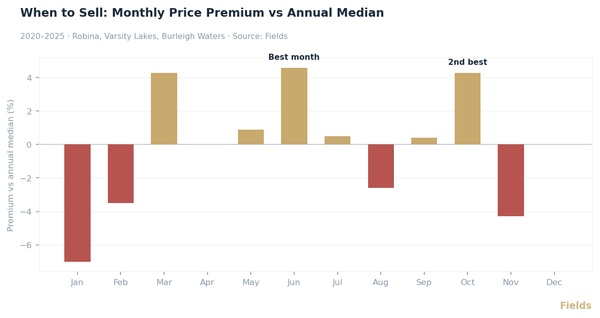
National and Gold Coast data consistently shows a modest seasonal effect. Listings in Q4 (October to December) tend to achieve slightly higher prices than those in Q2 (April to June), when stock levels peak and competition among sellers is greatest. Q1 carries a modest premium; Q3 is largely neutral.
We are currently in Q1 2026. SQM Research forecasts Gold Coast dwelling price growth of 7–11% for 2026,1 with some forecasters tracking as high as 13%.8 The market is not pausing for the calendar. A correctly priced, well-prepared Q1 listing competes in a market where buyer confidence remains elevated and stock levels have not yet peaked into the autumn-winter period. This is not a bad time to be selling.
That said, timing is worth planning around when circumstances permit. It is not worth delaying a well-prepared sale by six months to capture a seasonal premium. A correctly priced, well-presented home in April will outperform a poorly prepared home in October.
What Doesn't Work
The renovation trap
This bears repeating because the cost of getting it wrong is substantial.
Andrew Winter's observation from Section 5 applies directly here: in any comparable set of ten homes, the two immaculate move-in-ready properties and the two genuinely affordable original properties sell fastest. The six in the middle — the partially updated, moderately renovated homes — are the hardest to move.
The danger is that a moderate renovation pushes a property out of the affordable-project bracket without reaching the premium tier. The home is no longer cheap enough to attract renovation buyers, but not polished enough to command premium pricing. It sits in a pricing no-man's-land where days on market stretch and buyer interest thins.
Before committing to any improvement spend, map your post-renovation price against your suburb's price tiers. If the renovated price lands you in a slow-moving bracket, either go further (push through to the premium tier above) or don't start. A half-measure renovation is consistently the worst outcome.
Testing the market with an inflated price
Buyers in 2026 have access to the same valuation tools, the same comparable sales data, and the same market transparency as agents. There are no uninformed buyers. A property priced 15 per cent above comparable sales does not draw curiosity — it draws nothing. No enquiries, no opens, and after 45 days, a quiet consensus that something must be wrong with it.
The Darwin case study from our research files is instructive: a property listed just under $400,000 received not a single phone call over months on the market. When the price was corrected, it sold within days. The cost was not just the reduction — it was months of holding costs, compounding interest, and the irreversible perception damage of a stale listing.
Choosing the agent with the biggest billboard
Name recognition is not skill. Volume is not price performance. Choose the agent whose process — pricing methodology, buyer relationship strategy, negotiation approach — aligns with achieving the best outcome. Then trust that process.
The Priority List
If you are preparing to sell and want to apply this in order:
1. Establish your genuine market valuation — not what you want, what comparable buyers have paid in the last 90 days 2. Interview agents on their process, not their profile — ask for list-to-sale ratios on recent comparable properties 3. Commit to a full marketing budget — premium portal listing, professional photography, and social media reach 4. Prepare the property honestly — clean, clear, present the outdoor areas well; don't half-renovate 5. Commission a building and pest inspection before listing 6. **Set the
Disclaimer: The information in this article is for general informational purposes only and does not constitute financial, investment, or valuation advice. Fields Real Estate (Licence No. 4832971) makes no warranty as to the accuracy or currency of data published. Readers should conduct their own due diligence and seek independent professional advice before making any property or investment decision. Read our full disclaimer →