The Gold Coast Auction Buyer's Playbook: When to Bid, When to Wait, and What to Pay
Based on 10 years of Gold Coast sales data — 11,837 auction transactions across 82 suburbs. When to bid, when to wait, and what to pay.

The Gold Coast Auction Buyer's Playbook: When to Bid, When to Wait, and What to Pay
Based on 10 years of Gold Coast sales data — 11,837 auction transactions across 82 suburbs
The auction room is designed to make you feel like you're losing. The auctioneer is calling bids at pace. Someone else just went $10,000 above your limit. The crowd is watching. And in Queensland, there's no price guide on the door to tell you whether you're even in the right ballpark.
Most buyers walk into auctions either over-prepared with tactics they read on a blog or under-prepared with nothing but a gut feeling and a bank approval letter. Neither approach is grounded in what the data actually shows about how Gold Coast auctions perform.
So we ran the numbers. Ten years of sales records. 82 Gold Coast suburbs. 11,837 auction transactions. Here's what you actually need to know before you register your bidder's number.
The Auction Premium Myth — Debunked
Let's start with the question every buyer privately worries about: Am I going to pay more at auction than I would have in a private treaty negotiation?
The honest answer, based on current data, is: no.
We compared auction and private treaty sale prices across the Gold Coast using an automated valuation estimate as a common reference point — measuring each sale as a percentage of the property's current estimated value. This controls for the fact that auction properties tend to be larger or better-located than private treaty equivalents.
Southern Gold Coast — Houses (2020–2025):
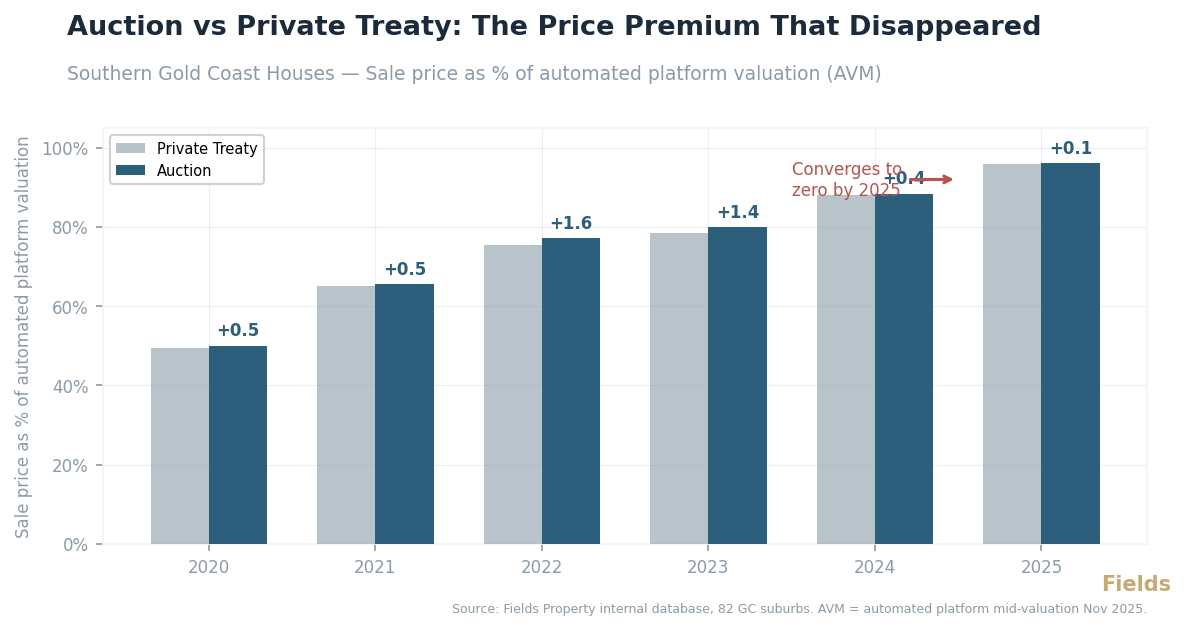
| Year | Private Treaty | Auction | Difference |
|---|---|---|---|
| 2022 | 75.3% of value | 76.9% of value | Auction +1.6 ppts |
| 2023 | 78.3% of value | 79.7% of value | Auction +1.4 ppts |
| 2024 | 87.8% of value | 88.1% of value | Auction +0.3 ppts |
| 2025 | 95.3% of value | 95.4% of value | Effectively zero |
In 2025, buyers at auction paid the same as buyers through private treaty — a difference of less than 0.1 percentage points. On a $1 million property, that's roughly $900. The auction premium that existed in 2021–2023 has converged to nothing.
This isn't unique to a slow period. It reflects a structural shift in how the Gold Coast market has settled after the post-COVID boom cycle.
What this means for you: Don't avoid an auction out of fear that you'll overpay relative to private treaty. That fear was more warranted in 2022. Right now, the method of sale is not what determines price — the property itself, your preparation, and your valuation accuracy are.
Queensland's Hidden Auction Rule: There Is No Price Guide
Before we go further — if you're coming from interstate, or you've bought privately before and this is your first Queensland auction, there's a rule that catches people off guard.
In Queensland, vendors are not required to provide a price guide for properties going to auction.
Unlike New South Wales (which mandates price guides) or Victoria (which publishes automated valuation estimates alongside listings), Queensland agents are legally permitted to run an entire auction campaign with zero indication of what the vendor expects. Many do exactly that.
This means the responsibility for valuation sits entirely with you. You need to arrive at the auction room with your own number — the maximum you will pay — calculated from real comparable sales, not from what you hope the property might be worth.
A practical framework:
Fields internal data shows that southern Gold Coast properties are currently selling at approximately the following percentages of their automated valuation estimate (2025 figures):
| Property Type | Price Range | Typical Sale as % of Automated Valuation |
|---|---|---|
| House | Under $700k | ~55–65% of AVM |
| House | $700k–$1.2M | ~68–75% of AVM |
| House | $1.2M–$2M | ~80–88% of AVM |
| House | Over $2M | ~84–90% of AVM |
| Unit/Townhouse | Under $700k | ~60–65% of AVM |
| Unit/Townhouse | $700k–$1.2M | ~77–80% of AVM |
| Unit/Townhouse | $1.2M–$2M | ~82–85% of AVM |
Use an automated valuation estimate as a starting anchor, apply the appropriate range for your property type and price band, and check it against three to five recent comparable sales from the same suburb and bedroom count. That gives you a defensible ceiling. Go to the auction knowing your number — not hoping to sense it from the room.
The Most Useful Thing Nobody Tells Buyers: Clearance Rates
Most buyers know what a clearance rate is in theory. Most don't use it as a practical buying tool.
They should.
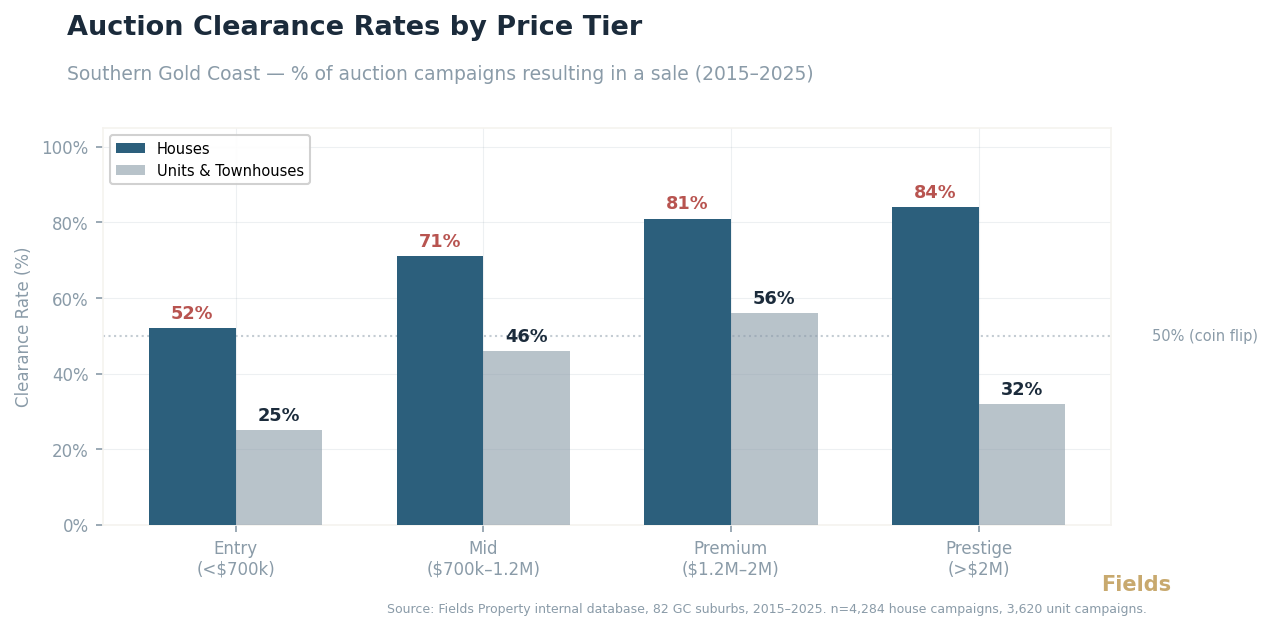
A clearance rate tells you the probability that an auction campaign ends in a sale on or before auction day — the inverse of which is your probability of getting a second chance through post-auction private treaty negotiation.
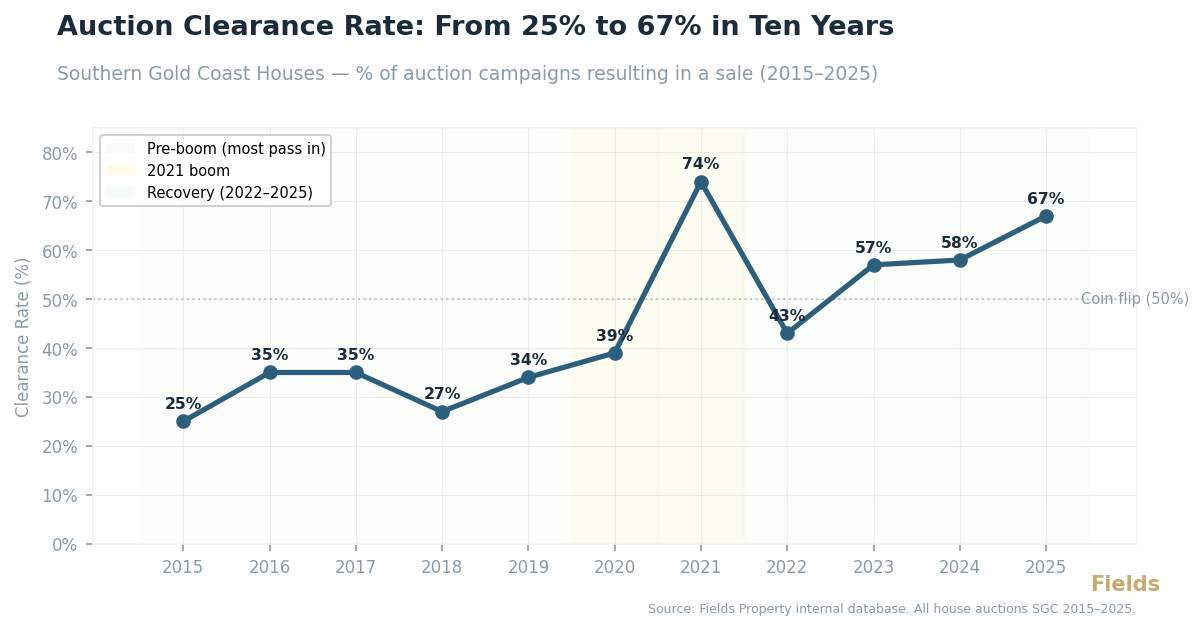
Here's what our data shows for the Southern Gold Coast over ten years:
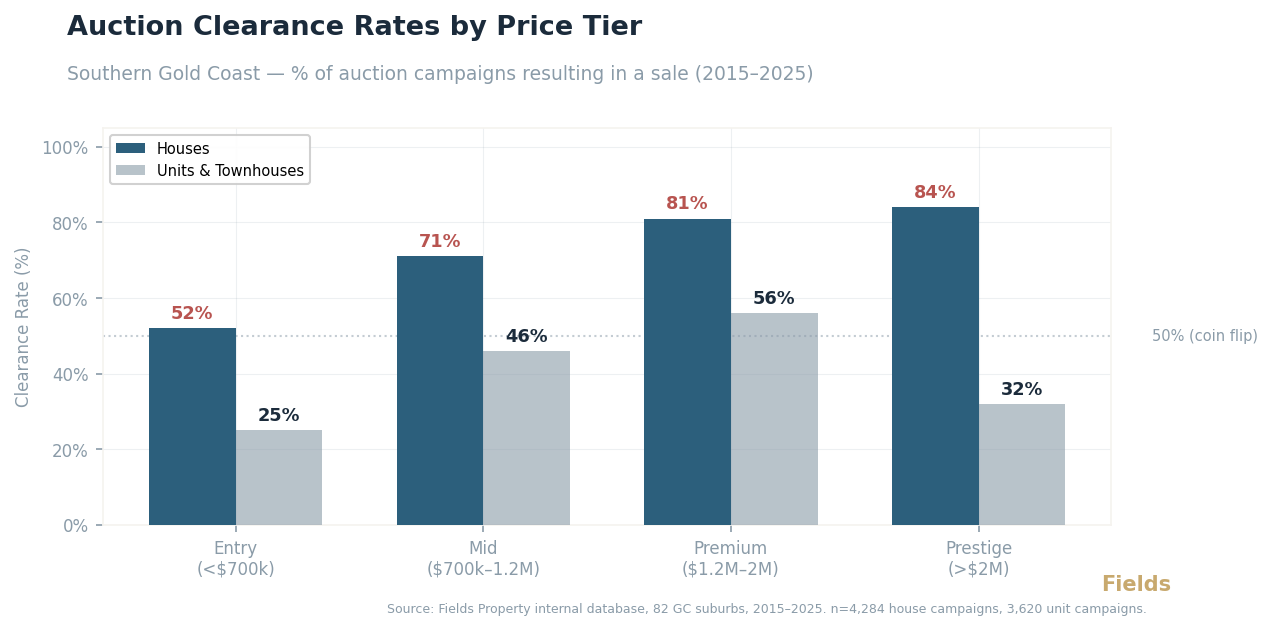
Houses — Clearance Rate by Price Tier:
| Price Tier | Campaigns | Sold | Clearance Rate |
|---|---|---|---|
| Under $700k | 576 | 299 | 51.9% |
| $700k–$1.2M | 1,264 | 897 | 71.0% |
| $1.2M–$2M | 1,087 | 884 | 81.3% |
| Over $2M | 513 | 429 | 83.6% |
Units & Townhouses — Clearance Rate by Price Tier:
| Price Tier | Campaigns | Sold | Clearance Rate |
|---|---|---|---|
| Under $700k | 1,860 | 461 | 24.8% |
| $700k–$1.2M | 952 | 438 | 46.0% |
| $1.2M–$2M | 369 | 206 | 55.8% |
| Over $2M | 439 | 142 | 32.3% |
The implications vary dramatically depending on what you're buying.
The Broader Auction Context: Where the Market Sits Now
Understanding your individual auction starts with understanding the broader market. For the week ending 28 February 2026, the national capital city clearance rate came in at 65.7% — down from 70.7% the prior week, driven by a surge of early-autumn listings, but ahead of the 62.6% recorded over the same week in 2025.1 Seasonal volume spikes routinely compress clearance rates; this reading reflects supply, not a change in buyer appetite.
Earlier in 2026, the market showed more conviction. National clearance rates surged to 73.7% in the opening weeks of the auction season — a meaningful rebound from the mid-60% range that characterised late 2025, when volumes and clearance rates wound down toward year-end.2,3
Gold Coast-specific clearance data is not yet included in the standard weekly national reporting datasets.1 For the Gold Coast market in early 2025, Apollo Auctions reported an average of 2.8 to 3.5 registered bidders per auction, with active participation (those who actually bid) ranging between 58% and 70%.4 That bidder depth is meaningful: it signals that registered buyers are genuinely committed, not spectators.
If You're Buying a House in the $700k–$2M Range
You need to be ready to bid on auction day. At the $700k–$1.2M tier, 71% of house auctions produce a sale. At $1.2M–$2M, it's 81%. In 2025 specifically, premium houses (the $1.2M–$2M tier) cleared at 95.7% — essentially every auction sold.
If you attend, watch, and plan to negotiate post-auction, you will miss the majority of properties you're interested in. The post-auction strategy is an occasionally viable tactic, not a reliable plan.
What to do: Have your building and pest inspection done before auction day. Have your finance pre-approved and confirmed, not just in-principle. Know your walk-away number. Show up prepared to bid.
If You're Buying a Prestige House (Over $2M)
Counterintuitively, the highest-priced properties have the highest clearance rates — 83.6% overall, and consistently above 89% in recent years.
This surprises most buyers. The assumption is that expensive properties have a smaller buyer pool and are therefore harder to sell at auction. The data shows the opposite: buyers at the $2M+ level have done thorough due diligence, have finance secured without conditions, and are genuinely committed. When they register to bid, they bid. Pass-in rates at the prestige level are low.
The prestige segment continues to set benchmarks. Palm Beach delivered the biggest headline of 2025: a $40 million beachfront sale at Jefferson Lane. In July 2025, an off-the-plan penthouse in Palm Beach sold for $9.1 million, setting a new unit record for the suburb.5 These results confirm that committed capital at the top end of the market is active and decisive — exactly what the clearance rate data reflects.
What to do: Don't assume you can watch a prestige auction and negotiate afterwards. Prepare as you would for any auction, and if the property is right for you at the right price, bid.
If You're Buying an Entry-Level Unit or Townhouse (Under $700k)
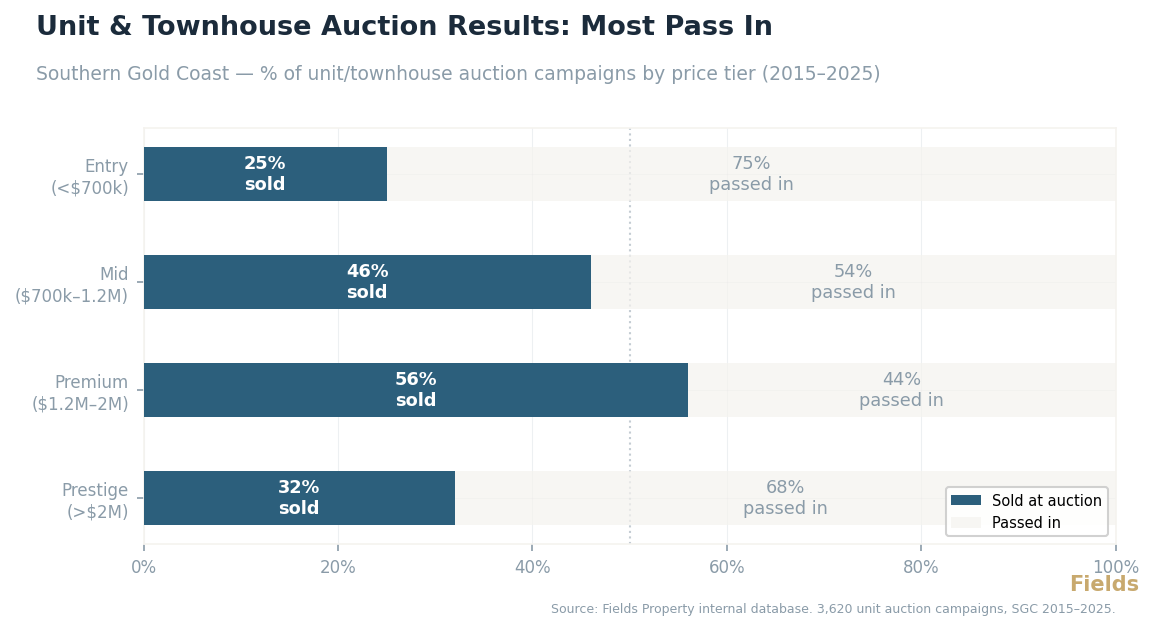
This is where the data gives buyers the most genuine tactical advantage.
Three-quarters of entry-level unit auctions — 75.2% — do not result in a sale on auction day. The auction passes in and the property transitions to private treaty negotiation. If you are buying in this segment, attending an auction without bidding is a genuinely viable strategy. You are likely to get a second chance.
Why does this happen? Entry-level units and townhouses are disproportionately purchased by investors — who typically require finance conditions, longer settlement terms, and due diligence around rental yield and body corporate. Unconditional auction contracts don't suit most investor profiles. The result is thin bidder numbers and frequent pass-ins.
What to do:
- Attend the auction. See who else registers. If there's light competition, hold back. - If the property passes in, you're now negotiating one-on-one with the vendor's agent with no competing bids. That's a structurally better position than a private treaty listing that's been advertised for three weeks. - If there are multiple registered bidders and the auction looks competitive, be prepared to engage rather than waiting for a pass-in that may not come.
The Pre-Auction Offer Strategy: Does It Actually Save You Money?
A common piece of buyer advice is: make a strong offer before auction day and avoid the pressure of the auction room. The theory is that vendors will accept a solid number in hand rather than risk the uncertainty of the auction.
The data is more nuanced than the advice suggests — and has shifted significantly since 2021.
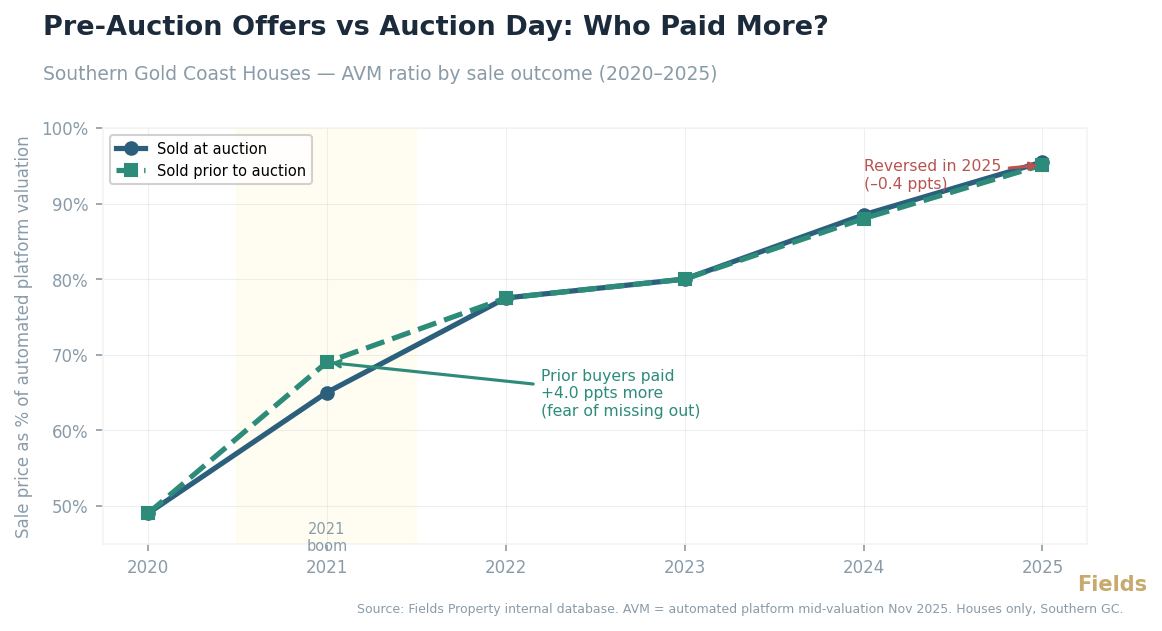
Southern GC Houses — Sold Prior vs At Auction (AVM ratio):
| Year | Sold Prior | At Auction | Direction |
|---|---|---|---|
| 2021 | 68.9% of value | 65.0% of value | Prior buyers paid +3.96 ppts MORE |
| 2022 | 77.3% of value | 76.9% of value | Prior buyers paid marginally more |
| 2023 | 79.7% of value | 79.7% of value | Identical |
| 2024 | 88.0% of value | 88.2% of value | At auction was cheaper |
| 2025 | 95.1% of value | 95.5% of value | At auction was cheaper |
In 2021, buyers who offered before auction day paid nearly 4 percentage points more than buyers who waited for auction day. In that market — where premium houses cleared at 100% and fear of missing out was at its peak — a pre-auction premium made rational sense.
That dynamic has reversed. In 2024 and 2025, buyers who secured properties prior to auction actually paid fractionally less than those who went through the full auction process. Vendors who accept pre-auction offers are now doing so at a slight discount to what the auction room would produce.
What this means in practice:
If you want to avoid the auction room, making a strong, unconditional pre-auction offer is now a reasonable strategy — and is unlikely to cost you a premium over what you would have paid at auction. Frame it as a clean offer (unconditional, or with minimal conditions), give the vendor a genuine decision to make, and don't apologise for trying.
If you're prepared to bid at auction and the property suits you, there is no price advantage to rushing a pre-auction offer in the current market.
The Auction Day Playbook
Tactics matter less than preparation. But for what it's worth, here's what the evidence and experience support:
Before the auction:
- Do your own valuation. Don't guess from the listing. - Complete building and pest inspection. These can't happen after the hammer falls. - Confirm your finance pre-approval is unconditional and confirmed — not just in-principle. Your broker should have spoken to a credit assessor, not just run a calculator. - Register to bid. You can always choose not to open your mouth. - Know your walk-away number. Write it down before you arrive.
On the day:
- You don't need to open the bidding. Letting someone else establish the floor at a low number costs you nothing. - Bid in firm, round increments. Small increments signal hesitation. Decisive bids signal a buyer who has done their homework and knows their number. - If the auctioneer refuses a bid as too small, accept their counter and adjust. Fighting the auctioneer on increment size is a distraction that serves no purpose. - Don't react to other bidders. Their body language, sighs, or apparent frustration are not information. They may be performing; they may not be. - When you've reached your number, stop. There is no property worth breaking a pre-determined limit for. If you've valued it properly, your number is your number.
If the property passes in:
In Queensland, when a property passes in, the highest bidder typically has the first right to negotiate privately with the vendor. This is your moment. The vendor has just seen their property fail to sell publicly — they are motivated to transact. Don't open with an apology for the auction result. Make a clean offer, set a reasonable timeframe, and let them decide.
What Type of Property Are You Buying? A Quick Guide
| Property | Clearance Rate | What This Means for You |
|---|---|---|
| House, $700k–$2M | 71–81% | Prepare to bid. Post-auction chance is real but minority |
| House, over $2M | 84%+ | Prepare to bid. Pass-in is uncommon |
| House, under $700k | 52% | Coin flip. Post-auction negotiation is a genuine option |
| Unit, under $700k | 25% | Most pass in. Watching and waiting is a legitimate strategy |
| Unit, $700k–$1.2M | 46% | Nearly half pass in. Be opportunistic but ready |
| Unit, over $1.2M | 56% | Slight majority sell. Be prepared to bid |
The Bottom Line
The Gold Coast auction market is not the 2021 auction market. The fever has broken. Buyers are not overpaying relative to private treaty. After a seasonal dip in clearance rates toward the end of 2025, the 2026 auction season opened with renewed conviction — national clearance rates reached 73.7% in the opening weeks before settling back to 65.7% for the high-volume week ending 28 February 2026.2,1 Conditions are active but measured. Pre-auction offers are no longer the discount-buying tool that some suggest — but they're not a premium either.
What the data supports is preparation over tactics. Know what the property is worth before you walk in. Know your number and respect it. Understand what clearance rate applies to your price tier and property type, and use that to decide how aggressively you need to pursue any given opportunity.
The buyers who consistently perform well at auction are not necessarily the most aggressive bidders in the room. They're the ones who did their homework before the auctioneer opened proceedings.
Sources
1. Wilson, A. / PropertyUpdate (2026) National Weekly Auction Report – February 28th 2026: Clearance Rates Lower Over Super Week of Auctions, PropertyUpdate. propertyupdate.com.au 2. Infinite Wealth (2026) 2026 Auction Season Rebounds Strongly, Infinite Wealth. infinitewealth.com.au 3. HamKerr (2026) Australian Real Estate Auction Market Wrap – Part II, HamKerr. hamkerr.com.au 4. Kollosche / Apollo Auctions (2025) The Gold Coast Auction Market in 2025, Kollosche. kollosche.com.au 5. COAST Buyer's Agency (2025) Gold Coast Suburbs Smashing Luxury Price Records in 2025, COAST Buyer's Agency. coastbuyersagency.com
Data sourced from Fields Property internal database, covering 82 Gold Coast suburbs, 2015–2025. AVM ratios calculated against automated platform valuations, November 2025. Total auction transactions analysed: 11,837 sold + 31,900+ passed-in campaigns. Price-tier clearance tables and AVM ratio figures last confirmed November 2025 — manual refresh recommended if more than 12 months have elapsed.
Fields Property — Southern Gold Coast property specialists.
Last reviewed: 2 March 2026
Disclaimer: The information in this article is for general informational purposes only and does not constitute financial, investment, or valuation advice. Fields Real Estate (Licence No. 4832971) makes no warranty as to the accuracy or currency of data published. Readers should conduct their own due diligence and seek independent professional advice before making any property or investment decision. Read our full disclaimer →