Robina's Fastest-Moving Year in Half a Decade
In 2025, 4.24% of all Robina properties changed hands — the highest turnover rate recorded in five years, and a decisive shift from the subdued activity of 2022 and 2023. That number matters because turnover is the clearest measure of how many owners actually committed to selling

Robina's Fastest-Moving Year in Half a Decade
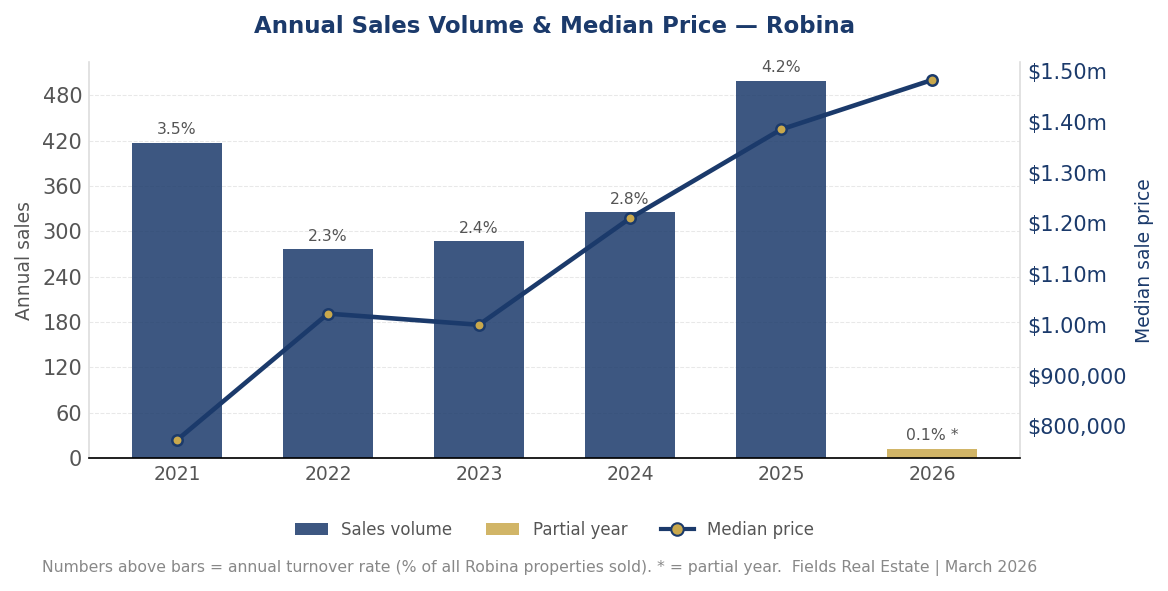
In 2025, 4.24% of all Robina properties changed hands — the highest turnover rate recorded in five years, and a decisive shift from the subdued activity of 2022 and 2023. That number matters because turnover is the clearest measure of how many owners actually committed to selling, and how many buyers followed through. In Robina last year, both sides showed up.
The full picture looks like this:
| Year | Sales | Turnover Rate | Median DOM | % Sold ≤30 Days | Median Price |
|---|---|---|---|---|---|
| 2021 | 417 | 3.54% | 10.0 days | 80.5% | $772,900 |
| 2022 | 276 | 2.34% | 19.0 days | 67.0% | $1,022,000 |
| 2023 | 287 | 2.44% | 25.0 days | 59.1% | $1,000,000 |
| 2024 | 325 | 2.76% | 21.0 days | 57.6% | $1,210,000 |
| 2025 | 499 | 4.24% | 22.0 days | 62.8% | $1,385,000 |
| 2026 ⚠️ | 12 | — | 23.0 days | 100.0% | $1,482,500 |
2026 data covers approximately three months only. Early-year figures — particularly the 100% sold within 30 days — are based on 12 transactions and should be read as a preliminary signal, not a confirmed trend.
What Happened in 2025
After three consecutive years of suppressed activity — 2022 and 2023 saw turnover fall below 2.50%, with 276 and 287 sales respectively — Robina broke out. 499 properties sold in 2025, the highest annual volume in the five-year dataset. Turnover climbed to 4.24%, surpassing even the 2021 pandemic-era peak of 3.54%.
That's not a correction. That's a market that reset itself and then some.
Median price reached $1,385,000 in 2025, up from $1,210,000 in 2024. The 2022–2023 period was the anomaly — prices held near the $1,000,000 mark while transaction volumes dried up. What 2025 confirmed is that the price gains were real, not speculative. Buyers paid them at scale.
The Supply Paradox
Here's the counterintuitive read on the 2022–2023 period: turnover below 2.50% wasn't a sign of a weak market — it was a sign of a reluctant one. Owners didn't need to sell. Fewer listings meant less competition for those who did. The buyers who were active had limited choice, and prices held.
The shift in 2025 tells a different story: more sellers entered the market, more buyers were ready, and the transaction engine cleared at a higher price point. The median days on market — 22 days in 2025 — shows that additional supply was absorbed without softening the pace. Listings weren't sitting. They were selling.
62.8% of 2025 sales completed within 30 days. That's up from 57.6% in 2024, and it confirms that buyer conviction — not just buyer presence — strengthened over the year.
The DOM Trend: What Speed Tells Sellers
The median days on market in 2021 was 10 days. That was an extraordinary moment — a near-frictionless market where listings cleared almost on contact. That kind of velocity doesn't persist, and it didn't. By 2023, median DOM had stretched to 25 days as buyer caution and rate pressure slowed decisions.
The recovery to 21 days in 2024, and then 22 days in 2025, matters less for its precision than for its direction. The market didn't keep softening. It tightened back up, and it held that tightness across a year of high volume.
For a seller, this is the key read: Robina absorbed nearly 500 transactions in 2025 at a pace of roughly one sale every 22 days per property. That's a market with genuine buyer depth, not one dependent on a handful of outlier sales.
2026: Too Early to Call, Worth Watching
The 12 sales recorded so far in 2026 all cleared within 30 days, and the median sits at $1,482,500. Both figures are directionally encouraging. But 12 transactions cannot carry the weight of a trend call. One anomalous sale in either direction shifts the median materially. Treat this as an early-year signal consistent with 2025's trajectory — nothing more.
What This Means If You're Considering Listing
Robina's 2025 data supports one clear conclusion: this is a market that can absorb listings. Volume was high, pace was consistent, and buyers committed at prices well above where they were two years ago.
A seller listing in early 2026 enters a market that moved 499 properties in the prior year at a median of $1,385,000 — with buyer absorption measured in weeks, not months. The question isn't whether the market can handle another listing. The data says it can.
The question is whether your pricing and presentation are calibrated for buyers who are moving quickly and paying close attention.
Fields operates across Robina and the broader southern Gold Coast. Know your ground.
Disclaimer: The information in this article is for general informational purposes only and does not constitute financial, investment, or valuation advice. Fields Real Estate (Licence No. 4832971) makes no warranty as to the accuracy or currency of data published. Readers should conduct their own due diligence and seek independent professional advice before making any property or investment decision. Read our full disclaimer →