Robina's Buyer-Friendly Conditions Hold — But Watch the Early Signals
Robina currently sits at 3.1 months of supply. That single figure places it in a different category from most of the southern Gold Coast right now — and for buyers active in the $1,300,000–$1,500,000 range, it matters.

Robina's Buyer-Friendly Conditions Hold — But Watch the Early Signals
Robina currently sits at 3.1 months of supply. That single figure places it in a different category from most of the southern Gold Coast right now — and for buyers active in the $1,300,000–$1,500,000 range, it matters.
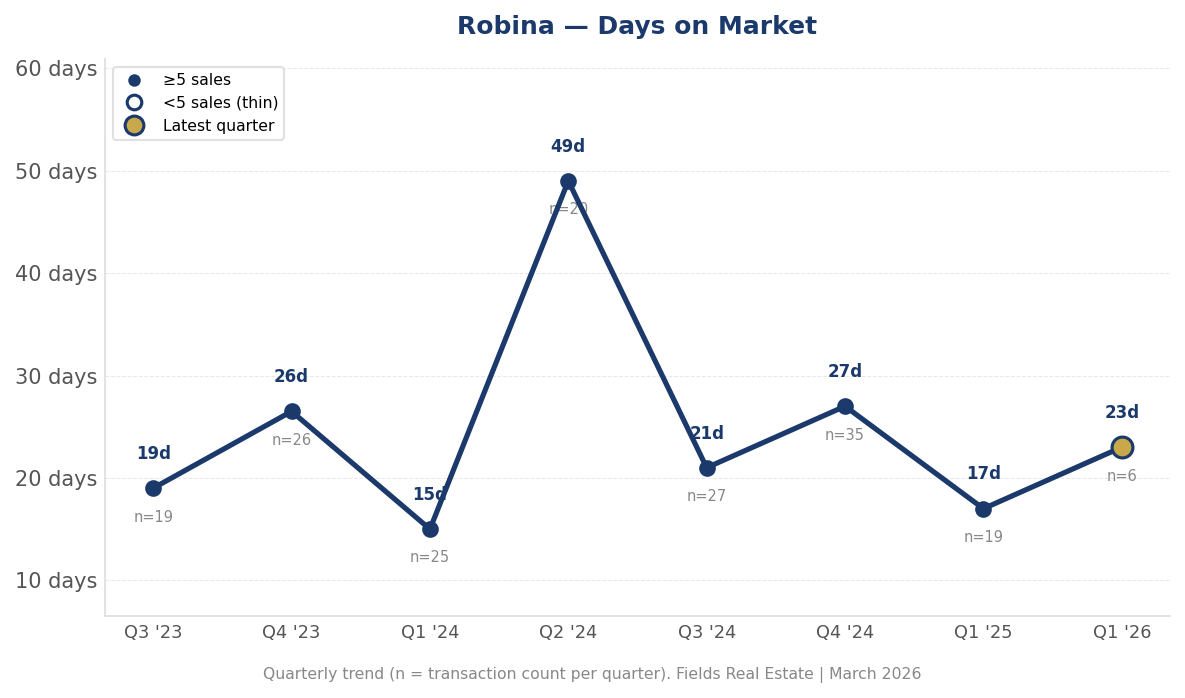
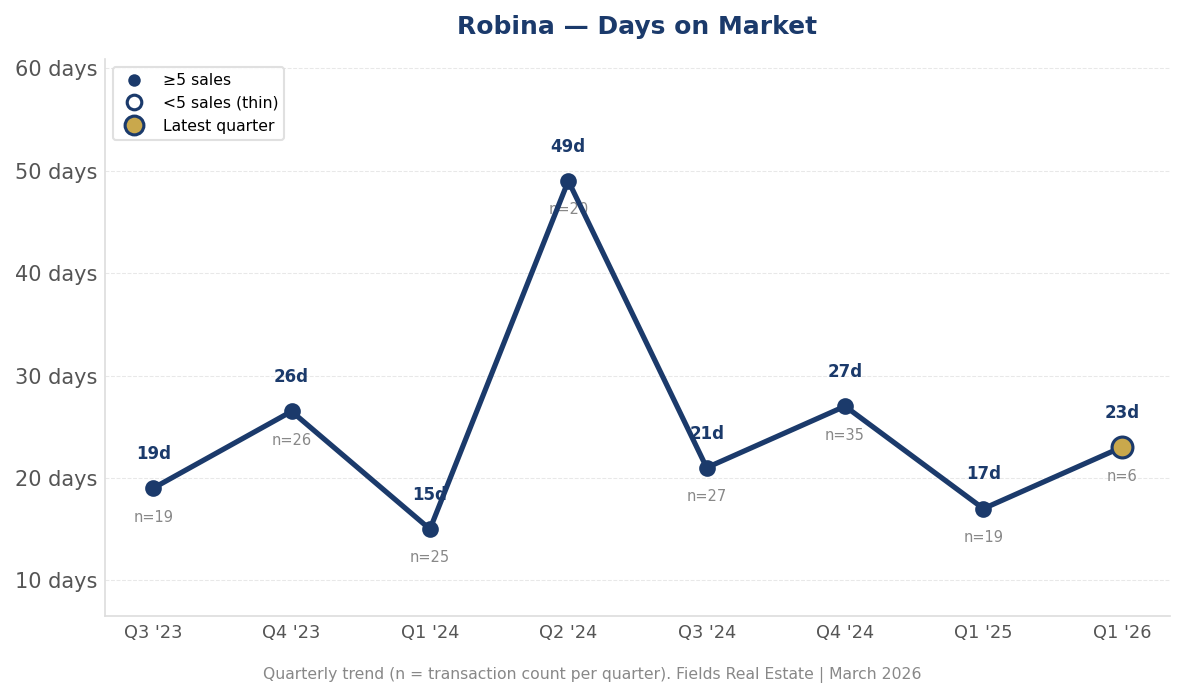
A balanced market typically runs between 2.0 and 2.5 months of supply. At 3.1 months, Robina has measurably more stock relative to the pace of absorption. Sellers are waiting longer. Buyers have more choice. That dynamic shows up clearly in the days-on-market figure: the median house in Robina sold in 23 days, compared to 15.5 days in Burleigh Waters. That gap is not cosmetic — it reflects a market where competing offers are not forming quickly, and where a considered buyer can negotiate without immediately losing the property.
The rolling 12-month median house price for Robina sits at $1,402,000, based on 135 house sales — a rise of +3.9% on the prior rolling 12 months. That is meaningful context. Varsity Lakes posted +14.7% over the same methodology. Robina's more modest growth rate is consistent with the supply picture: when buyers have room to move, prices move more slowly. Those two data points reinforce each other.
Volume also tells the story. Robina's trailing 12-month sales count stands at 181 house transactions — still running 43.4% below its prior 12-month peak. Suppressed volume typically limits the upward pressure on prices, because fewer competing buyers are active in the market at any one time. For a buyer, that means less urgency and more negotiating room than the headline price figure alone might suggest.
The Q4 2025 quarterly median for houses sits at $1,402,000, based on just 19 house sales. The prior quarter (Q3 2025) recorded 47 house sales. That drop in quarterly volume is significant and means the Q4 figure should be read alongside the more robust rolling 12-month number rather than in isolation.
Days-on-market data for early 2026 is based on just 6 transactions in Q1 2026 to date — too few to draw firm conclusions. Treat the 23-day figure as a directional indicator, not a settled reading.
The signal to watch: trailing 12-month volume has edged from 179 to 181 sales — a +1.1% move. Months of supply has ticked down slightly, from 3.2 to 3.1. Neither shift is dramatic, and both sit within normal variation. But the direction is consistent: absorption is incrementally improving. The window of buyer leverage that currently exists in Robina may be narrower in six months than it is today.
Worth flagging on asking prices: the median asking price for listed Robina houses sits at $1,230,000, against a median automated valuation estimate of $1,320,000 — a gap of -6.8%. Asking prices running below automated valuation estimates can reflect vendor expectations yet to fully reprice to current market levels, or a stock composition skewed toward the lower end of the market. Either way, it provides a useful reference point when anchoring offer strategy.
Stale listings — those that have been on market without a price reduction or fresh listing event — account for 17.5% of current Robina stock. At nearly one in five listings, that is a cohort of sellers who have already absorbed the cost of time on market. In a buyer's market, stale stock is often where negotiated outcomes occur.
The data underpinning this article spans five to six quarters of history. That is enough to identify directional trends but not enough to call a cycle with confidence. Treat these signals as informative, not predictive.
The practical position for buyers this week: Robina's current conditions support a disciplined approach — targeted offers, genuine due diligence, and willingness to negotiate on price or terms. The 3.1-month supply reading and 23-day median sale time suggest sellers are not fielding queues of competing buyers. Act with conviction, not urgency. The data supports it for now. Whether that remains true by mid-2026 is the question the next two quarters will answer.
Fields tracks house sales data across the southern Gold Coast. All price figures in this article refer to houses only.
Disclaimer: The information in this article is for general informational purposes only and does not constitute financial, investment, or valuation advice. Fields Real Estate (Licence No. 4832971) makes no warranty as to the accuracy or currency of data published. Readers should conduct their own due diligence and seek independent professional advice before making any property or investment decision. Read our full disclaimer →