Is Now a Good Time to Buy in Robina?
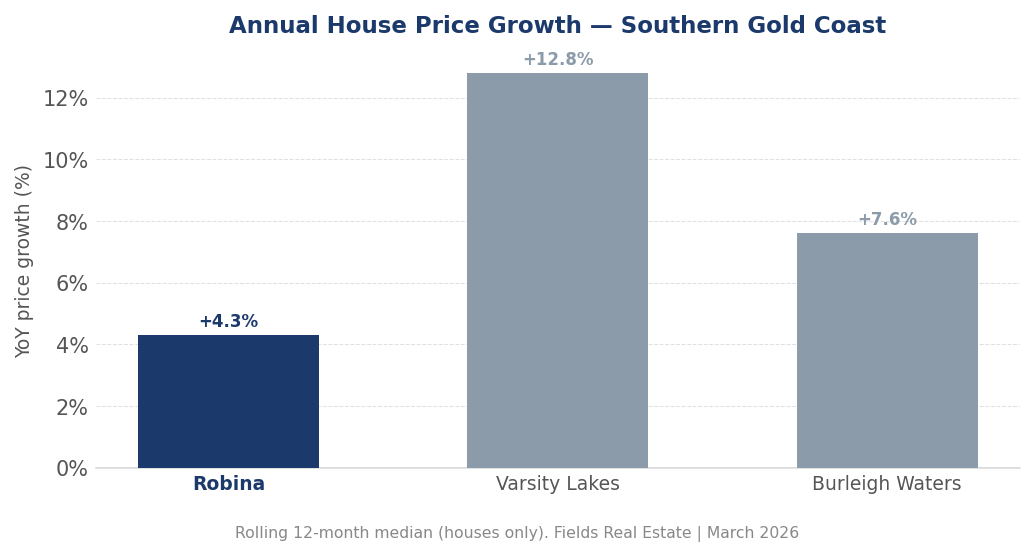
**Robina's rolling 12-month median house price has risen +4.3% over the past year while sales volume has contracted -42.0%. Those two numbers, read together, define the market you are buying into.**


Is Now a Good Time to Buy in Robina?
Robina's rolling 12-month median house price has risen +4.3% over the past year while sales volume has contracted -42.0%. Those two numbers, read together, define the market you are buying into.
By Fields Real Estate | March 2026
The rolling 12-month median house price in Robina sits at $1,407,500 today. Twelve months ago it was $1,350,000. Two years ago, $1,151,000. The suburb has added $256,500 in two years — genuine capital growth — but the pace has shifted depending on which window you examine. The earlier move, from $1,151,000 to $1,350,000, represented a gain of $199,000. The most recent twelve months added $57,500. The market did not reverse. It changed gear.
Where Are We in the Cycle?
Robina is in moderate growth. The rolling 12-month median gain of +4.3% is real, but context matters. The sharp repricing that defined the earlier cycle has moderated. A buyer entering in March 2026 faces a different risk profile than one who entered in 2023 or early 2024 — not because conditions have deteriorated, but because the momentum-driven gains have already been captured. What remains is measured, incremental movement.
The interquartile range adds important texture. The lower quartile sits at $1,261,250; the upper quartile at $1,605,000. That $343,750 spread confirms that Robina is not one market — it is several, stratified by location, land size, and build quality. Where you buy within Robina will shape your outcome more than the headline median suggests.
Buyer Power Right Now
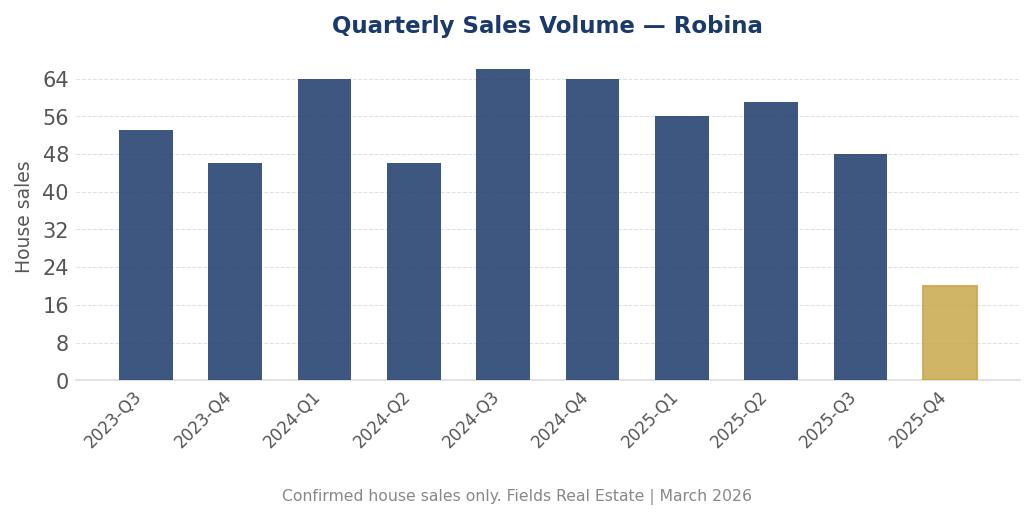
Robina recorded 142 house sales over the past twelve months. In the prior twelve months, 245 homes transacted — a -42.0% contraction in volume. That is not statistical noise. It is a significant reduction in activity, and it tells you that fewer buyers are transacting at current prices.
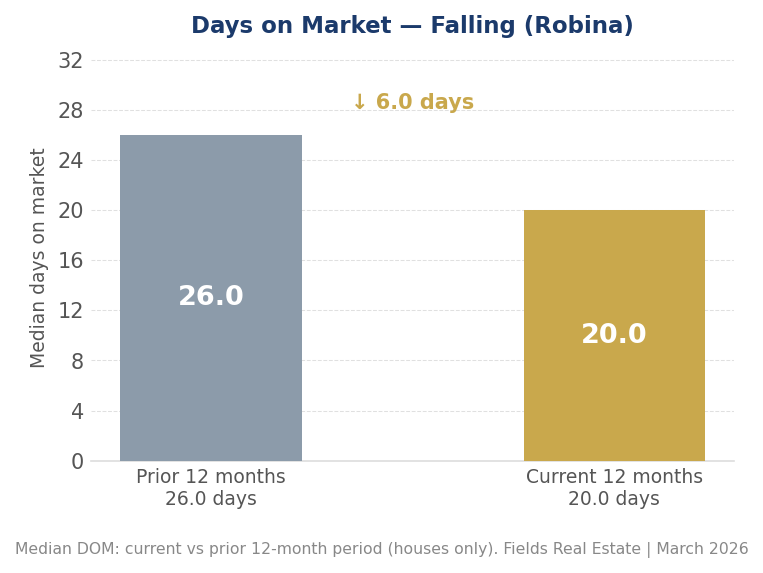
At the same time, the rolling 12-month median days on market fell from 26 days to 20 days. Correctly priced stock is clearing faster than it was a year ago, not slower.
Two signals pointing in opposite directions produce one clear reading: balanced. Fewer transactions are occurring, but those that do proceed are moving quickly. Sellers are not discounting to generate interest. Buyers are not competing in formation at every listing.
The practical implication is specific. A lowball offer on a well-priced property will not succeed — sold in 20 days means a correctly priced home can be gone before many buyers complete a second inspection. But the volume contraction creates real pockets of opportunity. Stock sitting well past that 20-day median without an offer is signalling something. Patient, prepared buyers can act on that signal without a crowd behind them.
This market does not reward urgency for its own sake. It rewards selectivity.
What the Rate Cut Actually Means
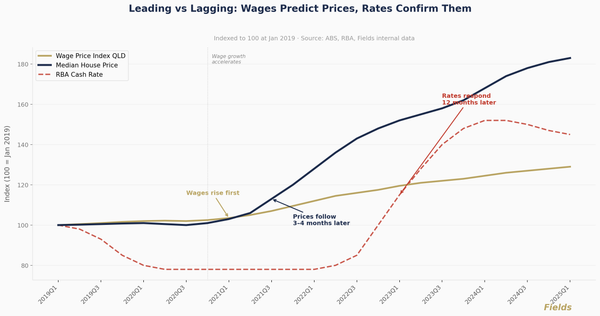
The RBA cut the cash rate by 25 basis points on 3 February 2026. It now sits at 3.85%, down from 4.10% twelve months prior. That move will be framed widely as a price catalyst. The more precise picture is worth understanding.
The correlation between RBA decisions and Gold Coast house prices is real — but the RBA reacts to what has already happened in the economy. Rate decisions lag Gold Coast prices by approximately twelve months. Waiting for rate cuts to validate a purchase decision means you are responding to yesterday's data, not tomorrow's movement.
A more reliable forward signal is the Queensland Wage Price Index, which leads Gold Coast prices by approximately one quarter. That data is not yet available for the current period. When it publishes, it will be worth watching closely. In the meantime, the rate cut improves borrowing capacity at the margin — but it should not be mistaken for a starting gun.
The Honest Answer
Reasons to buy now:
- The market is balanced, not seller-dominated. The volume contraction has reduced competition at open homes. A well-researched buyer with finance in order has more room to negotiate on the right property than they did twelve months ago. - The rolling 12-month growth of +4.3% reflects continued upward movement, not a market that has stalled or reversed. Entry now does not require betting on a recovery. - The lower quartile at $1,261,250 offers a foothold in a suburb with a demonstrated two-year growth trajectory of over $250,000.
Reasons to wait or proceed carefully:
- The -42.0% volume contraction is unusually sharp. Thin markets can be harder to exit. If your circumstances change and you need to sell within a short timeframe, fewer buyers transacting means fewer exit options. - At $1,407,500 median, Robina is not a suburb where errors in due diligence are cheap. The $343,750 interquartile spread means overpaying for the wrong property within the suburb is a genuine risk. - Without current Queensland Wage Price Index data, the most reliable forward indicator for Gold Coast prices is absent. Buying ahead of that data means accepting a degree of uncertainty about near-term direction.
The case for buying in Robina right now is reasonable — but only for buyers who have identified a specific property, understand where it sits within the suburb's price stratification, and are not dependent on short-term resale.
Analysis based on 142 confirmed house sales from the Gold_Coast.robina database. All figures are for houses only. Last reviewed: 2026-03-02. Fields Real Estate | Southern Gold Coast.
Disclaimer: The information in this article is for general informational purposes only and does not constitute financial, investment, or valuation advice. Fields Real Estate (Licence No. 4832971) makes no warranty as to the accuracy or currency of data published. Readers should conduct their own due diligence and seek independent professional advice before making any property or investment decision. Read our full disclaimer →