Gold Coast Airport: From 6.2 Million Passengers to 13 Million by 2044
20-year master plan approved June 2025. From 6.2 million passengers to 13 million by 2044.

Gold Coast Airport: From 6.2 Million Passengers to 13 Million by 2044
Status: 20-Year Master Plan approved June 2025 — actively progressing Operator: Queensland Airports Limited (QAL) Location: Bilinga / Coolangatta (on the Queensland–NSW border) Current capacity: 6.2 million passengers per year Target by 2032 (Olympics): 10 million passengers per year Target by 2044: 13 million passengers per year 20-year economic contribution: Nearly double to $990 million per annum; 6,000+ jobs
Overview
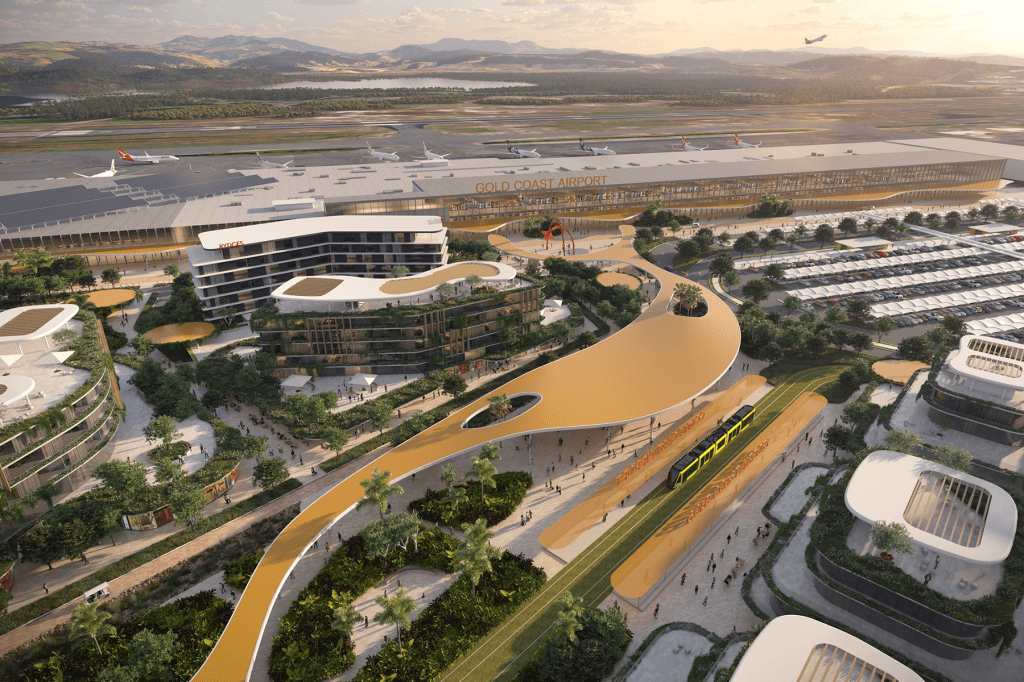
Gold Coast Airport is Australia's sixth-busiest airport and the primary international and domestic gateway for the southern Gold Coast, northern New South Wales, and the broader coastal tourism corridor. On 23 June 2025, Federal Minister for Infrastructure Catherine King MP approved Queensland Airports Limited's 2024 Master Plan18 — a 20-year transformation blueprint that will reshape the airport from a busy terminal into a fully integrated airport city precinct.
The timing is deliberate: the first 8 years of the Master Plan are squarely focused on delivering the infrastructure needed for the 2032 Brisbane Olympic and Paralympic Games, when the airport is expected to handle unprecedented passenger volumes.11
Queensland Airports Limited has also recently completed a 74.25% stake sale to KKR and Skip Capital, signalling new investment capacity behind the Master Plan's delivery.11
What the Master Plan Delivers
Near-Term (2025–2032): Transformation for the Olympics
- Expanded terminal and hotel precinct: Larger hotel area adjacent to the terminal, with multiple accommodation options to serve the growing leisure, business, and Games visitor market - Retail village: A destination retail and dining precinct beyond the existing terminal offer - Health and wellness hub: New health-focused amenity within the airport precinct - Conference and technology centre: Business event capability to attract corporate and convention traffic - Public transport plaza: An integrated transport hub linking buses, taxis, rideshare, and future light rail / heavy rail connections11 - Net zero emissions by 2030: Scope 1 and Scope 2 greenhouse gas emissions targeted at net zero across airport operations
Long-Term (2032–2044): Airport City Vision
- Heavy rail link at the Bilinga site: Long-term provision for a heavy rail station connecting the airport to the Queensland rail network — consistent with the preserved corridor running alongside the M1 - Full mixed-use precinct transformation: The airport precinct evolves into a destination in its own right — a multi-use urban node with employment, hospitality, education, and community facilities
The Foundation: The $260 Million Terminal Expansion
The 2024 Master Plan builds on a major expansion already delivered. The two-stage Project LIFT terminal redevelopment — with Stage 1 completed in 2017 and Stage 2 completed in November 2022 — represented a $260 million investment that:1
- Doubled the terminal footprint to 30,000m² - Added four glass aerobridges (the airport had none previously — passengers walked across the tarmac) - Installed international swing gates enabling greater flexibility between international and domestic operations - Significantly improved the passenger experience
Following the shift of international services to the new terminal, the airport completed a $17 million refurbishment of its former international area to expand domestic capabilities, and has since opened an expanded domestic departure lounge.12
The Master Plan takes this as the baseline and builds a much more ambitious vision on top of it.
Passenger Capacity Growth Trajectory
| Year | Projected Passengers |
|---|---|
| Current | ~6.2 million |
| 2032 (Olympic Games target) | 10 million |
| 2044 (Master Plan horizon) | 13 million |
Doubling passenger throughput in eight years is an ambitious target that requires significant terminal, airfield, and ground transport investment. The Games period will be the stress test — managing extraordinary peak demand with the infrastructure built under the first phase of the Master Plan.
New international routes are adding to the growth trajectory. Fiji Airways is scheduled to launch a nonstop Gold Coast–Nadi service on 11 June 2026, subject to final approvals.15
The Transport Gap: No Rail to the Airport
One of the most significant facts about Gold Coast Airport is that it has no rail connection. The nearest rail stations are:
- Varsity Lakes (heavy rail) — approximately 8–10 km north by road - Coolangatta bus services — direct but slow and traffic-dependent
Gold Coast Light Rail Stage 4 — which would have run directly past the airport en route to Coolangatta — was cancelled in September 2025. The cancellation leaves the airport dependent on bus and road access for the foreseeable future.
The Master Plan acknowledges this gap. The public transport plaza is designed to improve the ground transport experience for buses, rideshare, and future connections.11 The Gold Coast City Transport Strategy 2031 includes an extension of the G:link light rail to the airport, and the South East Queensland Infrastructure Plan envisions extending the Gold Coast Line train to the airport — but as of early 2026, neither project has been approved to begin construction.
For the 2032 Olympics, airport-to-venue transport will rely on: - Enhanced bus services (the replacement for Stage 4 light rail) - The upgraded M1 motorway (completed November 2025) - Point-to-point vehicle movements (rideshare, taxis, hire cars)
This is a real gap in the Games transport plan that the Queensland Government acknowledges but has not resolved.
What It Means for Bilinga, Tugun, and Coolangatta
Gold Coast Airport sits on the Queensland-NSW border, with its entrance in Bilinga. Its growth has direct implications for the immediately surrounding suburbs:
Employment: The airport is already a major employer in the southern Gold Coast. The 6,000+ jobs projected over 20 years represent a significant expansion of the employment base in an area that has historically been dominated by tourism and hospitality.11
Bilinga: The suburb immediately adjacent to the airport entrance will benefit from improved precinct amenity and employment opportunity. The hotel and commercial development within the airport precinct will create accommodation and service demand in Bilinga.
Tugun: The suburb immediately north of the airport is the primary residential neighbourhood for airport workers and is already well-regarded for its relative affordability compared to other coastal suburbs. Continued airport growth is a structural employment anchor for Tugun.
Coolangatta: The broader Coolangatta precinct benefits from the airport's tourism gateway role. However, the lack of rail connectivity remains a constraint on how efficiently the airport can move large volumes of visitors into and through the region.
Property context: These suburbs did not receive Light Rail Stage 4. Their growth trajectory is driven by lifestyle value, relative affordability, the airport employment anchor, and the long-term airport precinct vision — not by rapid transit infrastructure. Investors should price them accordingly.
Southern Cross University: An Unusual Asset
One of the most distinctive features of Gold Coast Airport is that Southern Cross University operates a campus within the airport precinct. This is genuinely unusual — very few universities worldwide are embedded within operating airports.
The campus primarily serves students in health, business, and technology disciplines. Its continued expansion under the Master Plan reinforces the airport precinct as a mixed-use employment and education destination, not purely a transit facility.
Sources
1. Gold Coast Airport (2025) Development Plans, Gold Coast Airport. goldcoastairport.com.au 11. Gold Coast Airport (2025) Gold Coast Airport Master Plan, Gold Coast Airport. goldcoastairport.com.au 12. Gold Coast Airport (2024) Development Plans — Domestic Expansion, Gold Coast Airport. goldcoastairport.com.au 15. The Traveler (2026) Fiji Airways, Qantas and Jetstar Supercharge Gold Coast Airport With 2026 Route Boom, The Traveler. thetraveler.org 18. Travel Weekly (2025) Gold Coast Airport receives federal government approval for its 2024 Master Plan, Travel Weekly Australia. travelweekly.com.au
Article first published: February 2026. Last reviewed: 2 March 2026. Review triggers: any major construction contract announcements under the Master Plan; 2032 Olympics transport planning updates for the airport; heavy rail extension feasibility study announcements.
Disclaimer: The information in this article is for general informational purposes only and does not constitute financial, investment, or valuation advice. Fields Real Estate (Licence No. 4832971) makes no warranty as to the accuracy or currency of data published. Readers should conduct their own due diligence and seek independent professional advice before making any property or investment decision. Read our full disclaimer →