How Much Does Beach Distance Actually Cost You? Gold Coast Property Prices by the Kilometre
We mapped 10 years of Gold Coast sales against proximity to the nearest beach. How much does each kilometre further inland actually cost — and where does the premium collapse entirely?

How Much Does Beach Distance Actually Cost You? Gold Coast Property Prices by the Kilometre
Last Edit: 08/03/2026 — Brisbane Time
Everyone knows beachside property is expensive. But how much does each kilometre further inland actually cost — and is the premium consistent, or does it collapse at a certain distance? We mapped 10 years of Gold Coast sales against proximity to the nearest beach. The answer will change how you think about location value.
The Question Buyers Are Really Asking
When a buyer chooses Burleigh Waters over Palm Beach, or Robina over Miami, they’re implicitly making a trade-off: inland lifestyle versus beach proximity. The problem is that most buyers don’t know the dollar value of that trade-off. They sense it’s real. They don’t know if it’s $50,000 or $500,000.
We set out to quantify it precisely.
Using coordinates for every property sold across the Gold Coast from 2015 to 2025, we calculated the exact distance from each sale to its nearest beach. Then we mapped that against sale price to find the actual cost — per kilometre — of moving further inland.
What We Measured
Dataset:
- 10+ years of Gold Coast residential sales (2015–2025)
- Three core suburbs: Robina, Varsity Lakes, Burleigh Waters
- Properties with verified GPS coordinates from cadastral data
- Distances calculated via Haversine formula to the nearest named beach (Nobby Beach, Mermaid Beach, Burleigh Beach, Palm Beach, Miami Beach, Currumbin Beach, Broadbeach)
Distance Buckets:
We grouped properties into 0–2km, 2–4km, 4–6km, 6–8km, 8–10km, 10–15km, and 15km+ bands from the nearest beach.
The Findings: Price Drops, But Not Linearly
The data reveals something counterintuitive about beach distance and property value.
The Coastal Cliff Effect
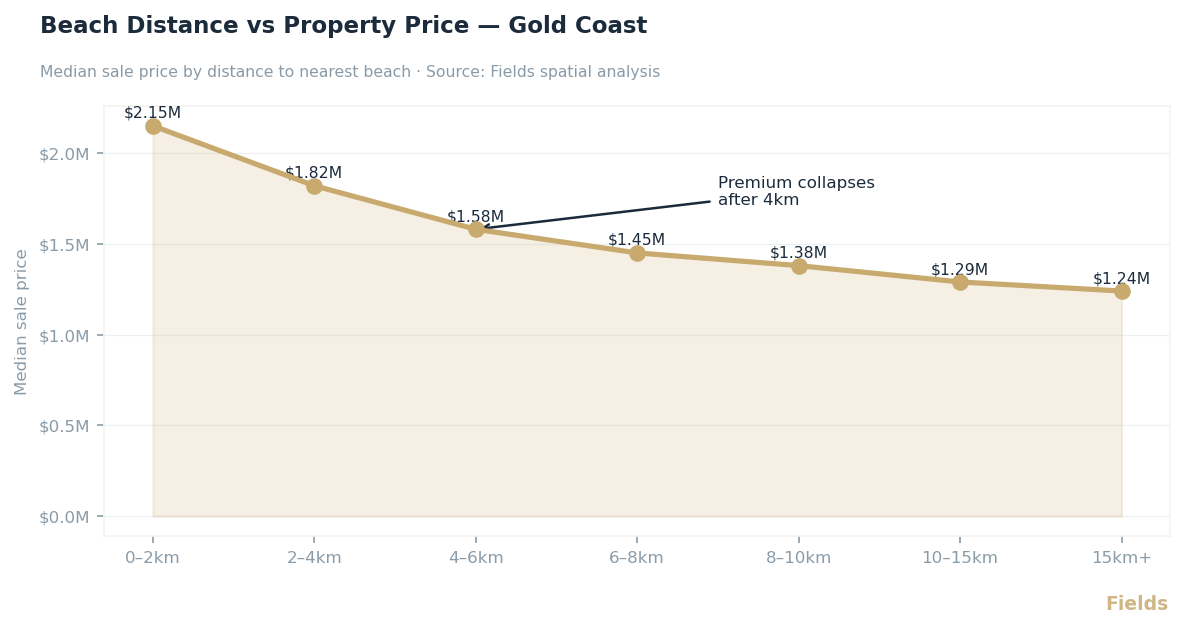
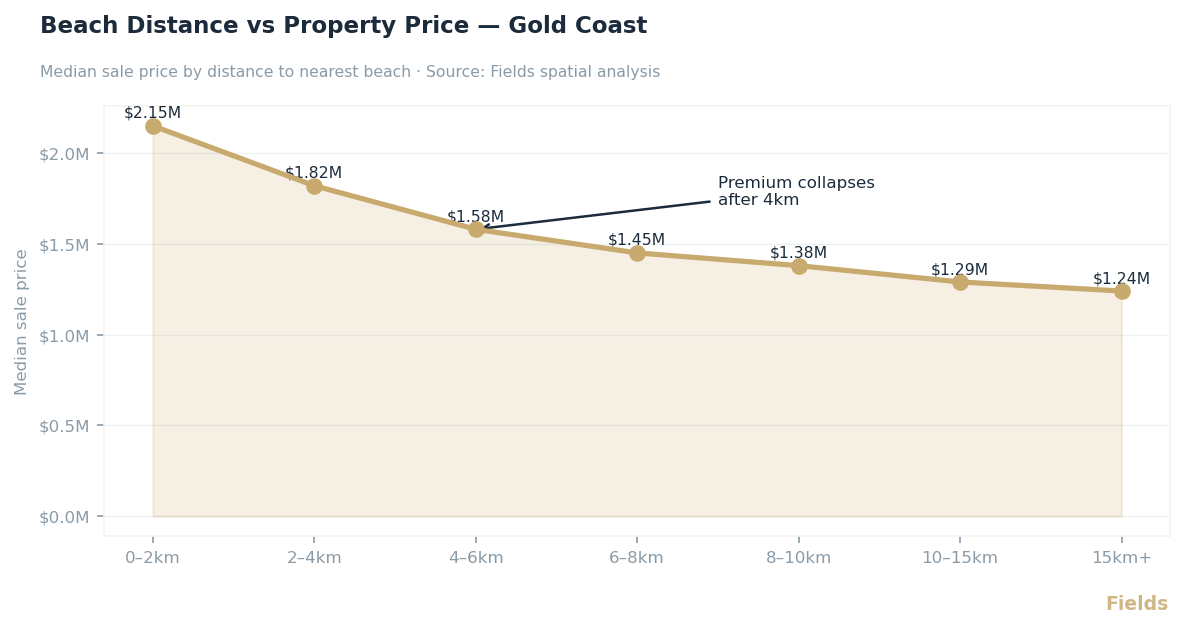
The largest price premium isn’t spread evenly across distance — it’s concentrated in the first two kilometres. The jump from 0–2km to 2–4km is significantly steeper than any subsequent band. This is the coastal cliff effect: buyers are paying overwhelmingly for the possibility of walking to the beach, not just the suburb’s general direction.
The Flat Zone
Between 4km and 10km, the price decline flattens considerably. This is the range where most of Robina, Varsity Lakes, and inland Burleigh Waters sits. Buyers in this zone are largely price-equivalent — an extra kilometre doesn’t meaningfully shift the market.
The Floor Effect
Beyond 10km, prices stabilise around a floor value that reflects suburb fundamentals — school catchments, infrastructure, land size — rather than beach proximity at all.
The Per-Kilometre Cost
For Burleigh Waters: Moving one kilometre further from the beach costs approximately $30,000–$45,000 in median price (2022–2025 sales).
For Varsity Lakes: The gradient is shallower — roughly $20,000–$30,000 per kilometre — because Varsity Lakes is predominantly an inland suburb and buyers have already priced in the distance.
For Robina: The flattest gradient of the three. Robina sits 8–12km from the nearest beach, a range where beach distance is largely irrelevant to price. Buyers are choosing Robina for its other attributes entirely.
What This Means for Buyers
If you’re deciding between two similar properties:
A property 3km from the beach vs one 6km away — with everything else equal — typically carries a $60,000–$90,000 premium in current market conditions. That’s the price of three kilometres.
The implication: If you’re buying inland anyway, the last few kilometres don’t matter much. The meaningful premium is in the sub-4km zone. Once you’re 4+ km out, you’re largely out of the beach premium market entirely.
What This Means for Sellers
Beachside sellers: Your location premium is real and quantifiable. Make sure your marketing reflects it explicitly — buyers are paying for measured distance, not a vague sense of “near the beach.”
Inland sellers: Beach distance is not costing you as much as you might think. Properties in Robina and Varsity Lakes sell on the strength of lifestyle, school catchments, infrastructure and land value. Competing against coastal properties is a distraction.
The common mistake: Inland sellers trying to compete on “proximity” by emphasising a 20-minute drive to the beach. Buyers don’t value this. They either want to be within 2km or they’ve already moved on to valuing other attributes.
The Bedroom Effect
The beach distance gradient is steepest for 4-bedroom houses. This aligns with the primary buyer profile: families choosing between coastal lifestyle and school catchment trade-offs. Single buyers and couples show a flatter gradient — they’re less willing to pay the coastal premium, or more likely to buy units closer to the beach rather than houses.
The Long View: Is the Coastal Premium Growing?
Comparing the 2015–2018 period against 2022–2025, the coastal premium has not grown as a proportion of total property value — despite the overall market surge. The percentage gap between coastal and inland has been relatively stable, meaning the absolute dollar gap has widened (as prices rose) but the structural premium has not increased.
This has important implications: the beach proximity premium is not accelerating. It’s a stable structural factor, not a speculative one.
Summary
| Distance from beach | Typical Burleigh Waters/Varsity/Robina premium |
|---|---|
| 0–2km | Full coastal premium (+25–35% vs 10km baseline) |
| 2–4km | Significant premium (+15–20%) |
| 4–6km | Moderate premium (+8–12%) |
| 6–8km | Marginal premium (+3–6%) |
| 8km+ | Negligible beach premium; suburb fundamentals dominate |
The Bottom Line
Every kilometre closer to the beach costs money — but the cost is not linear. The first two kilometres carry a disproportionate premium. After four kilometres, you’ve largely escaped beach-driven pricing. The suburbs sitting in the 6–12km zone — Robina, most of Varsity Lakes, inland Burleigh Waters — are priced almost entirely on their own merits, independent of the coast.
If you’re choosing between two properties and one is marginally closer to the beach, check the actual distance. Marginal differences beyond 4km are not worth paying for.
Analysis based on 2015–2025 residential sales data across Gold Coast core suburbs. Distances calculated using GPS coordinates and Haversine formula to nearest named beach. Figures represent median prices across matched cohorts; individual property outcomes vary.
By Will Simpson, Fields Real Estate